

From an export to a live channel
1
You import a chat export
You upload WhatsApp
.csv or .txt files, or an Intercom .json export.
Hundreds of files is normal.2
Kai splits the files into conversations
Kai groups the messages into conversations, then into sessions. A session
is one continuous exchange, not a whole year of contact with one customer.
3
Kai replaces personal data with placeholders
Every phone number, email address and payment reference becomes a stable
placeholder. This happens before any model reads a word. The same value
always becomes the same placeholder, so Kai can still learn the pattern
without holding the value.
4
Kai compiles a Brain
Kai groups questions that mean the same thing, picks the best answer your
team gave, and derives your brand voice, your conversation flows and your
human handoff rules.
5
You review it
You approve, edit or reject each item. Nothing is live.
6
You connect a channel
Intercom or WhatsApp Cloud. You choose copilot, autopilot or off.
7
Kai drafts or replies
Every action is recorded with the reasoning behind it.
The compile reads your history. It never reads your live customer data to
build a Brain unless you ask for that in a retrain.
The six parts of a Brain
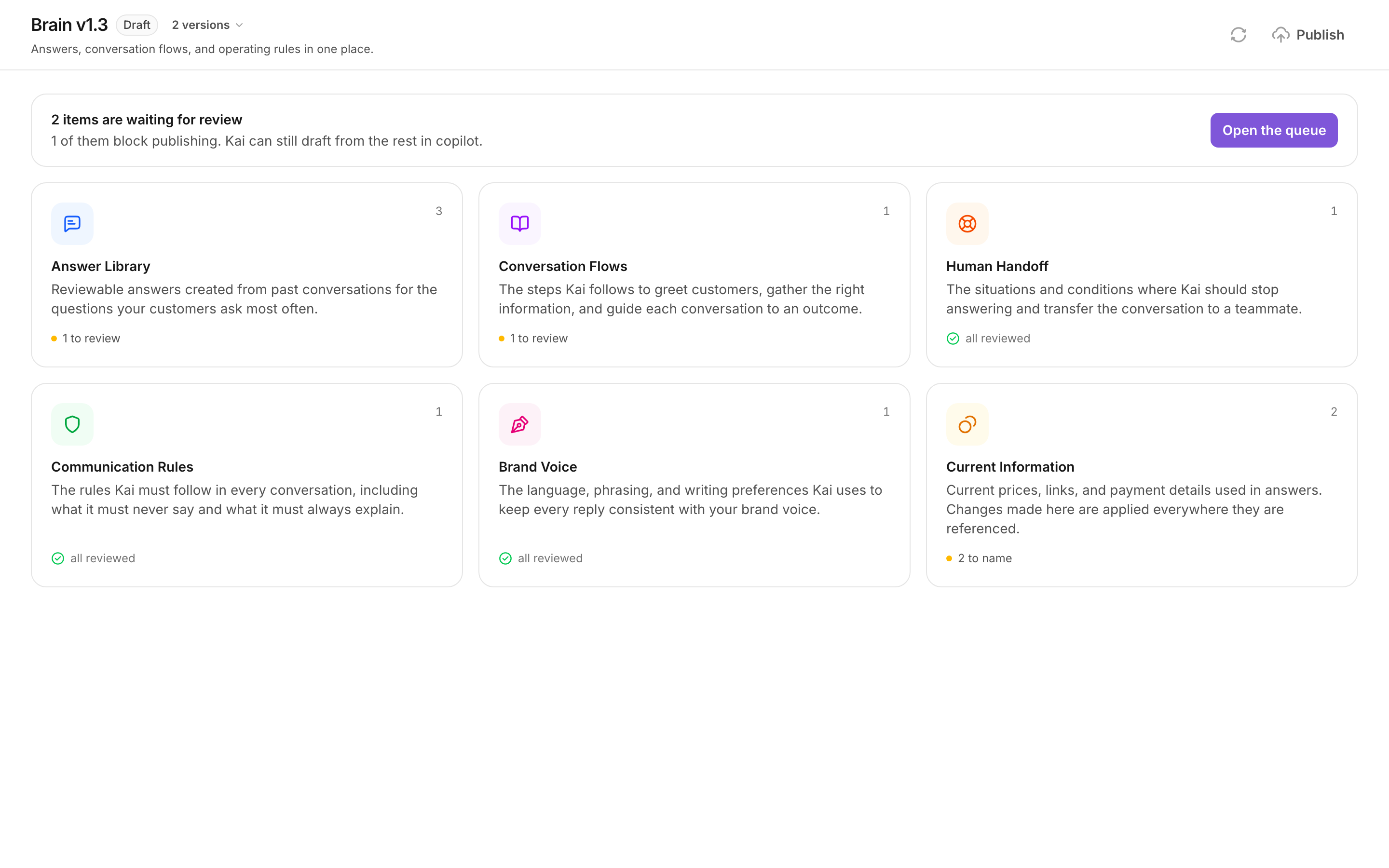
The Brain page: six categories, and a banner when items wait for review.
What happens to one live message
A customer writes. Kai does six things, in this order.1
Kai waits for the customer to finish
Customers send one thought across several short messages. Kai waits a fixed
number of seconds, 20 by default, and every new message pushes the wait
forward. If you switch on Follow the customer’s typing rhythm, Kai
waits longer while messages still arrive in a burst.
2
Kai classifies the message
Kai works out the intent and the language.
3
Kai looks up the answer library
Kai retrieves the answers and the conversation flow that match the intent.
4
Kai writes a reply
The reply uses only what the Brain holds. Kai does not answer from general
knowledge.
5
Kai checks the reply against the rules
The checks are deterministic and run on the text Kai produced, not on its
intentions.
6
Kai decides
Kai replies, writes a draft, escalates to a teammate, or stays quiet.
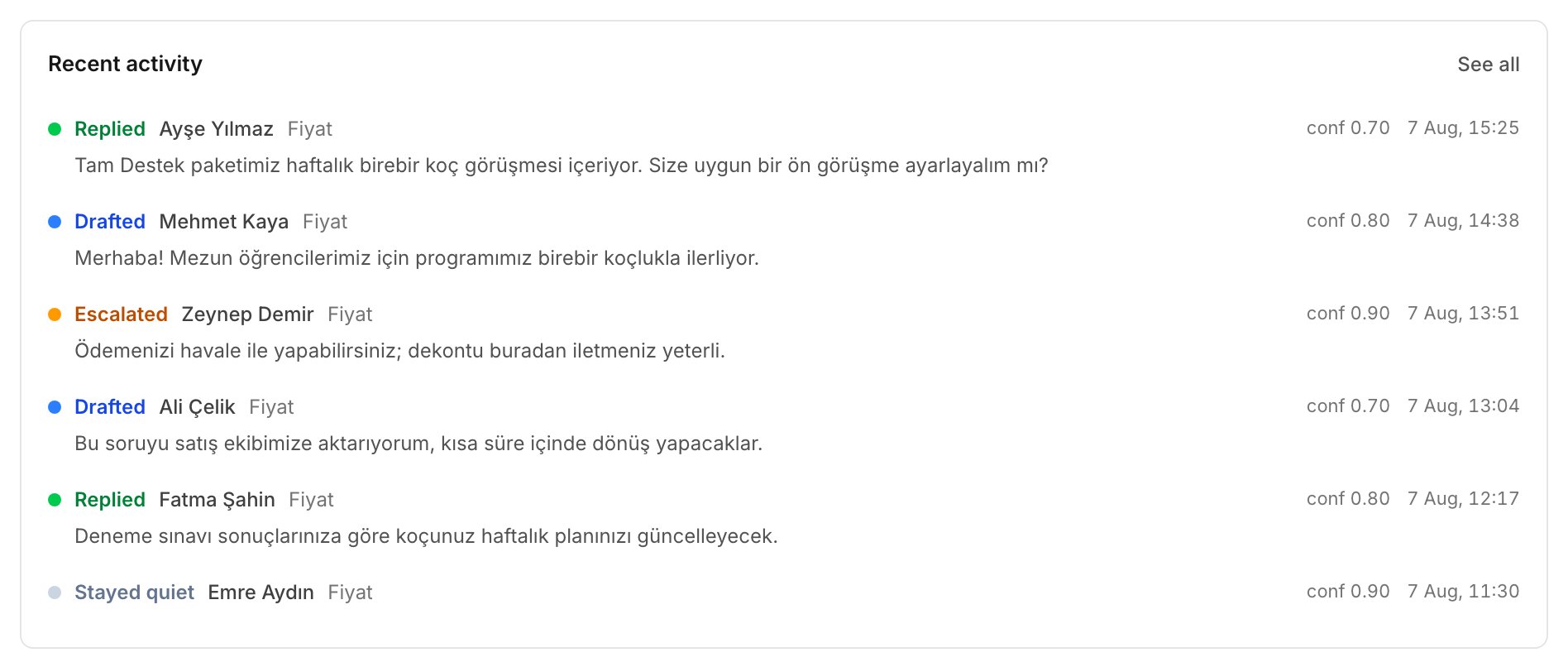
Recent activity: what Kai did, with the confidence behind each action.
The groundedness rule
A number in a reply must come from somewhere Kai can point to. It must appear in one of three places:- Current Information, which your team maintains;
- a non-volatile answer in the answer library, such as a lesson count;
- the conversation itself, where the customer or a teammate wrote it.
The takeover rule
When a human replies on a conversation, Kai stops acting on it. The conversation stays with your team until they close it. This holds on every channel. In Intercom, Kai reads which replies were typed in the inbox by a person, and which were written by an app. A reply typed by a teammate is a takeover. A reply written through an app is not. The rule exists so that two voices never answer the same customer at the same time. A conversation that a person owns stays owned by that person.Brain versions
A Brain has a version, such asv1. A channel is pinned to one published
version, and it answers from that version only.
Publishing freezes a version. After a publish, the version cannot be
edited. This is what makes an action traceable: the Brain that produced a reply
last month still exists, word for word.
To change a published Brain, use Edit as a new draft. Kai opens a copy and
carries your review decisions across. The published version keeps serving your
channels while you work on the copy. The copy is v1.1, then v1.2, and so
on. A new compile from a new import gives you v2.
What blocks a publish
Publishing is blocked only by content that could reach a customer without a person reading it:- Brand Voice;
- every Human Handoff rule;
- every Conversation Flow that autopilot may use;
- the answers those flows use.
Next
Get started
Do all of this once, from sign-up to the first draft.
Copilot, autopilot and off
The modes, the two autopilot scopes, and per-source settings.