

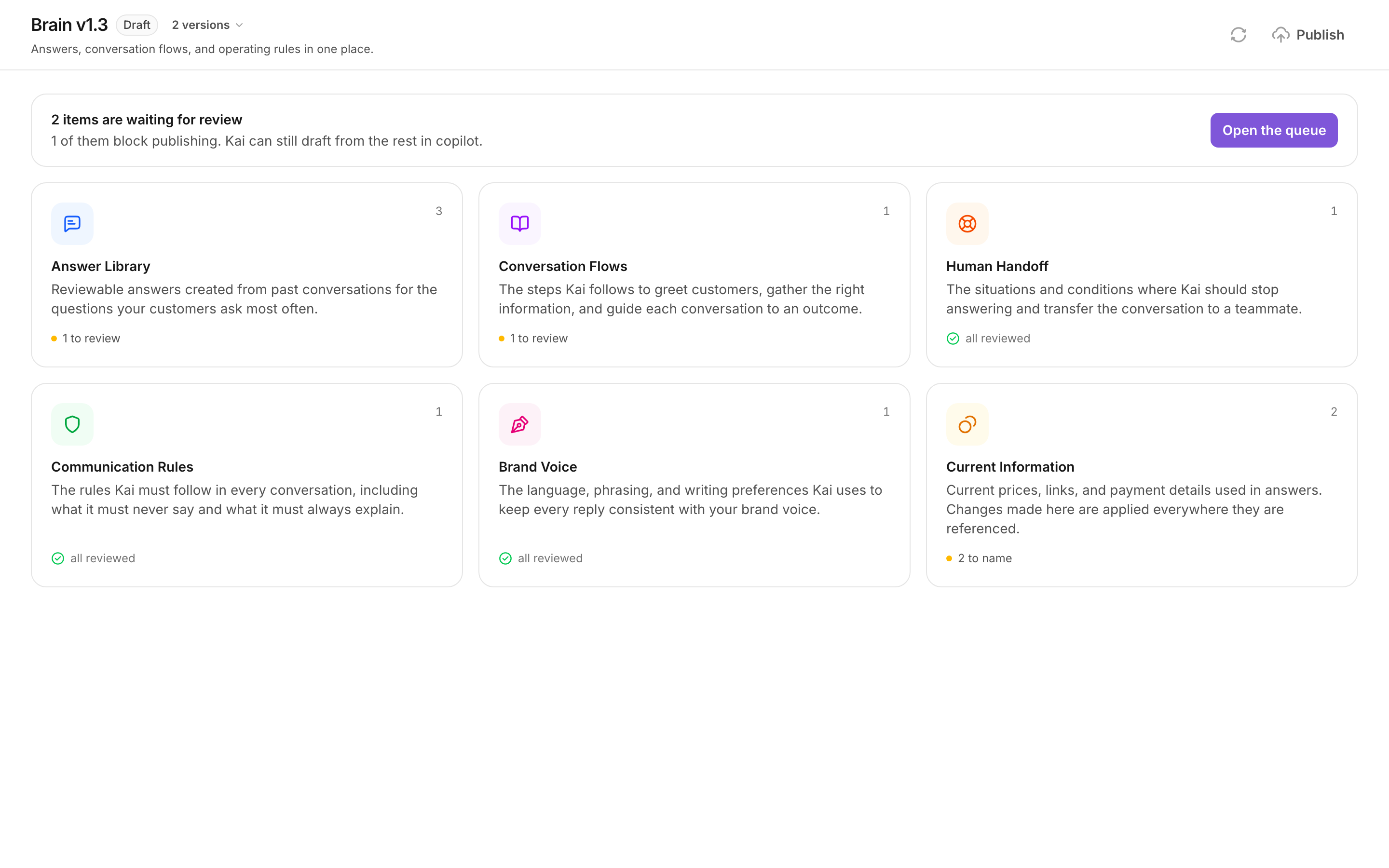
Current information is a category on the Brain page.
Why it is separate
The other five categories are part of a Brain version. A version is frozen when you publish it, so a change there needs a new draft, a review, and a publish. A fact is not part of a version. A change to a fact takes effect on the next reply. There is no review state, and there is no publish step.A price change should not need a compile. Your prices change more often than
your answers do, and freezing them inside a published version would make every
price change a release.
What a fact holds
The key cannot hold spaces. Kai lowercases it and replaces the rest.
How an answer uses a fact
An answer never carries the value. It carries a token:- A Link and an IBAN never enter the prompt at all. Kai only ever sees the token, and the runtime substitutes the exact value.
- A Price and a Text fact are shown to Kai as live data, so Kai can reason with the number, and the value is still substituted exactly.
Placeholders waiting for a name
Kai replaces every phone number, email address, link and payment reference with a placeholder before any model reads your history. A placeholder looks like[URL_13] or [IBAN_2].
When the compiler produced an answer that mentions one, the answer cannot be
sent until you say what the placeholder is. The Brain page counts these as
to name, and Current Information lists them under Placeholders from your
history.
1
Read the list
Each row shows the placeholder, how many answers mention it, and an excerpt
of one of them, so you can see what the value was used for.
2
Let Kai propose the names
Select Suggest names. Kai reads where each placeholder appears and
proposes a name, a description and a type. Where the import still holds the
original value on this machine, Kai fills that in too. Nothing is saved yet.
3
Confirm each one
Select Name this on a row. Check every field, correct the value, and
select Save.
4
Read the result
Kai states how many mentions it rewrote across the Brain. Every answer that
used the placeholder now uses the fact.
Naming a placeholder rewrites the Brain, so it needs an editable draft. On a
published version the list is read-only. Select Edit as a new draft first.
How this meets the groundedness rule
Kai checks its own output before it sends. A number in a reply must appear in one of three places:- a fact in current information;
- an answer that is not marked as changing over time;
- the conversation itself, because a customer’s own number is safe to repeat.
When to use a fact instead of an answer
Use a fact when:- the value changes on its own schedule: a price, a discount, an instalment count;
- the value must be exact: an IBAN, a link, a reference number;
- the value appears in more than one answer, and all of them must agree.
- the number is part of the explanation and never changes, for example how many coaching sessions a week the programme has;
- the number belongs to one answer only and is not money.
Maintaining the register
- Edit changes the value everywhere it is used, on the next reply.
- Delete removes the fact. Any answer that still names it will be downgraded to a draft, so search the Answer Library first.
- The list is grouped by type, so twenty facts read as four short lists.
Next
The knowledge base
The other five categories, and what a review state means.
Review and publish
What publishing freezes, and what it does not.