> ## Documentation Index
> Fetch the complete documentation index at: https://docs.kaisupport.com/llms.txt
> Use this file to discover all available pages before exploring further.
# Get started
> From sign-up to Kai's first draft in your inbox, with what good looks like at each step.
This page is the whole first run. Follow it once, and Kai writes its first
draft in your inbox at the end.
Set aside about one hour of your own time. The compile runs on our server and
needs none of your attention.
The set-up wizard has four steps:
1. **Import your history**
2. **Review your Brain**
3. **Connect a channel**
4. **Choose copilot or autopilot**
Sign in, then give the workspace the name your team uses for the business. The
name appears on the set-up page and in the product.
The person who creates the workspace becomes **Admin**. An Admin can do
everything, including erasing raw uploads. Add your teammates later, in
**Settings → People**. A role change takes effect on the next session refresh,
under a minute.
**Time:** about two minutes.
The first wizard step is **Import your history**. Drop your export on the panel
that says **Drop your chat export here**, or use **Choose files**.
Kai reads:
* WhatsApp `.csv` or `.txt` files;
* an Intercom `.json` export.
Select the whole folder. Hundreds of files is normal, and a large export is
split into several uploads automatically.
Then select **Compile my Brain**.
Kai replaces every phone number, email address and payment reference with a
placeholder before any model reads a word. You can delete the raw upload at
any time, in **Settings → Data controls**.
**What good looks like:** at least a few hundred real conversations, from the
team and the topics you want Kai to cover. Sales chats and support chats
compile into different answers, so upload what you want Kai to handle. Group
chats between your own staff add noise, so leave them out.
**Time:** two to ten minutes, mostly upload.
The panel shows the percent done, the stage, and how much time is left. The
five stages are:
| Stage | What happens |
| -------------------------------------- | --------------------------------------------------------------------------------------------------- |
| **Queued** | Your files are on our server. The run starts shortly. |
| **Reading your conversations** | Kai splits chats into sessions and replaces personal data with placeholders. |
| **Understanding what customers asked** | One pass per conversation: what it was about, and how it ended. |
| **Building your Brain** | Kai groups equal questions, picks the best answer your team gave, and derives your voice and flows. |
| **Ready to review** | Nothing is live. Nothing goes live until you approve it. |
 This runs on our server, not in your browser. Close the tab and come back.
**What good looks like:** the counts under the progress bar match your export.
If Kai reports far fewer conversations than you uploaded, the export format is
probably wrong. Try another export.
**Time:** a few minutes for a few hundred conversations.
The second wizard step is **Review your Brain**. Open the Brain page. It shows
six categories, and a banner when items wait for a decision.
This runs on our server, not in your browser. Close the tab and come back.
**What good looks like:** the counts under the progress bar match your export.
If Kai reports far fewer conversations than you uploaded, the export format is
probably wrong. Try another export.
**Time:** a few minutes for a few hundred conversations.
The second wizard step is **Review your Brain**. Open the Brain page. It shows
six categories, and a banner when items wait for a decision.
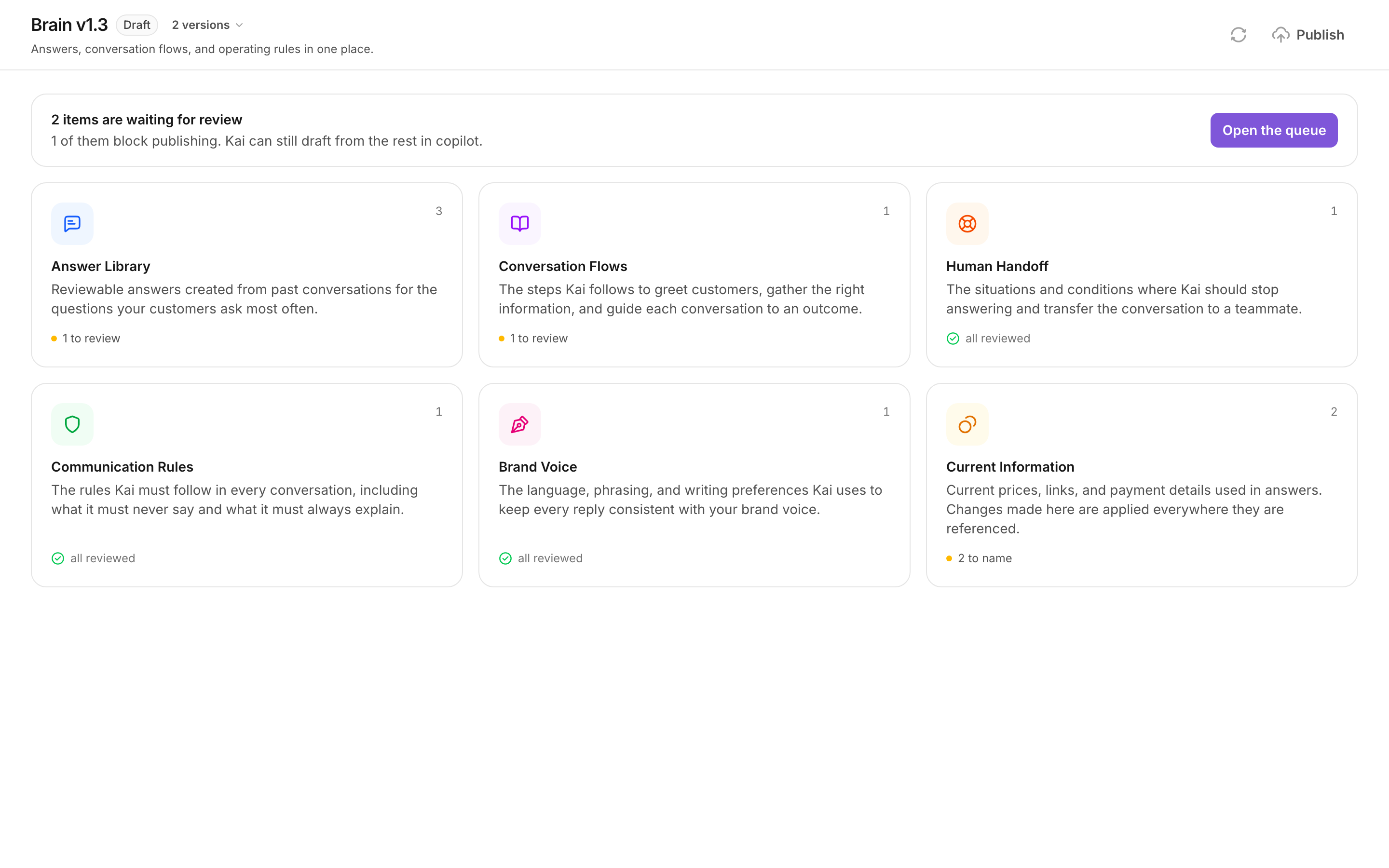 Select **Open the queue**. The queue is sorted with the blockers first, then by
how often customers ask. For each item you can:
* **Approve** it, if the text is right as it is;
* edit the text and **Save and approve**, which records you as the reviewer;
* **Reject** it, if Kai should never say this.
Items badged **Blocks publishing** must have a decision before you can publish.
Those are your brand voice, every human handoff rule, every conversation flow
that autopilot may use, and the answers those flows use. Everything else may
stay unreviewed: unreviewed content drafts for a human and never sends on its
own.
Fill in **Current Information** as well. Your real prices, links and payment
details live there. Answers pull the value from that one place, so a price
change later is one edit, with no review and no publish.
You do not have to finish the queue before you go live. Copilot works on an
unreviewed draft, because a person reads every word. Review the first thirty
or so answers, then let real traffic show you which of the rest matter.
**What good looks like:** you read an answer and think "yes, that is how we say
it". If you are editing almost every answer, the export was probably the wrong
set of conversations.
**Time:** thirty to ninety minutes for a first pass. It is the one step that
needs a person who knows the business.
The third wizard step is **Connect a channel**. Go to **Settings → Channels**.
Select **Open the queue**. The queue is sorted with the blockers first, then by
how often customers ask. For each item you can:
* **Approve** it, if the text is right as it is;
* edit the text and **Save and approve**, which records you as the reviewer;
* **Reject** it, if Kai should never say this.
Items badged **Blocks publishing** must have a decision before you can publish.
Those are your brand voice, every human handoff rule, every conversation flow
that autopilot may use, and the answers those flows use. Everything else may
stay unreviewed: unreviewed content drafts for a human and never sends on its
own.
Fill in **Current Information** as well. Your real prices, links and payment
details live there. Answers pull the value from that one place, so a price
change later is one edit, with no review and no publish.
You do not have to finish the queue before you go live. Copilot works on an
unreviewed draft, because a person reads every word. Review the first thirty
or so answers, then let real traffic show you which of the rest matter.
**What good looks like:** you read an answer and think "yes, that is how we say
it". If you are editing almost every answer, the export was probably the wrong
set of conversations.
**Time:** thirty to ninety minutes for a first pass. It is the one step that
needs a person who knows the business.
The third wizard step is **Connect a channel**. Go to **Settings → Channels**.
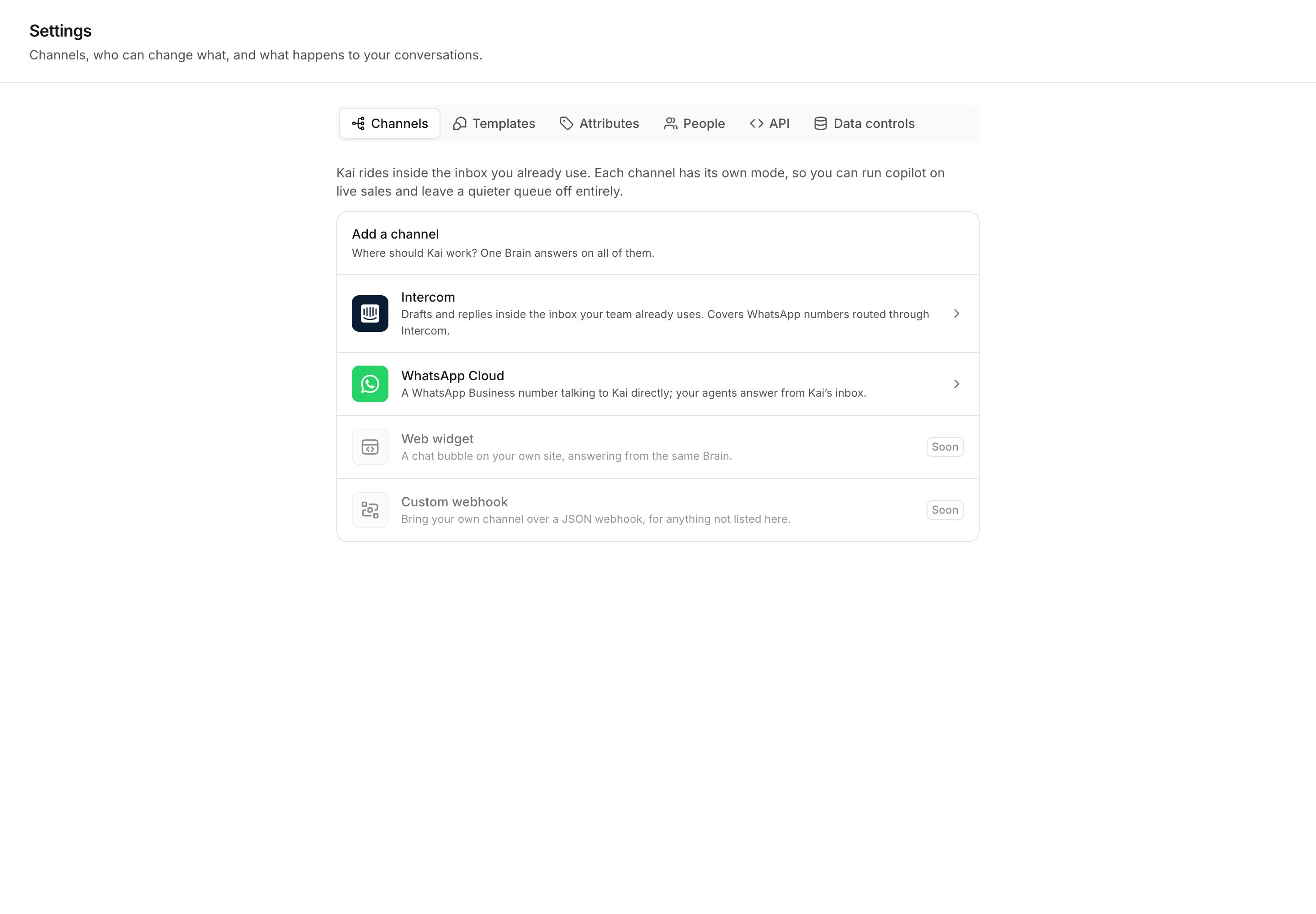 Two channels are available:
* **Intercom.** Kai works inside the inbox your team already uses. Drafts
arrive as internal notes, and a handoff is an assignment. This also covers
WhatsApp numbers routed through Intercom.
* **WhatsApp Cloud.** A WhatsApp Business number talks to Kai directly, and
your team answers from Kai's own inbox.
Add the channel, then use **Show delivery URL** to get the address the provider
must post to. Put that address in Intercom's Developer Hub, or in the Meta app
dashboard under WhatsApp > Configuration. Treat the address like a password.
For Intercom, **Test connection** confirms the credential works. For WhatsApp
Cloud, the card checks four steps in turn and tells you which one fails.
A channel needs a published Brain before it can act. If the card says no
Brain is pinned, publish one first.
**What good looks like:** the card shows the channel as connected, and entries
appear under **Recent activity** as the provider delivers messages.
**Time:** ten to twenty minutes, most of it in the provider's dashboard.
The fourth wizard step is **Choose copilot or autopilot**. Choose **Copilot**.
In copilot, Kai writes a draft and a coaching note. A human reads it and sends
it. Nothing reaches a customer unread. This is how you find out what Kai gets
right before it can answer alone.
Select **Save policy**.
**Time:** one minute.
Open the inbox. When a customer writes, Kai waits for them to finish, then
writes a draft above the composer under **Kai suggests:**.
Two channels are available:
* **Intercom.** Kai works inside the inbox your team already uses. Drafts
arrive as internal notes, and a handoff is an assignment. This also covers
WhatsApp numbers routed through Intercom.
* **WhatsApp Cloud.** A WhatsApp Business number talks to Kai directly, and
your team answers from Kai's own inbox.
Add the channel, then use **Show delivery URL** to get the address the provider
must post to. Put that address in Intercom's Developer Hub, or in the Meta app
dashboard under WhatsApp > Configuration. Treat the address like a password.
For Intercom, **Test connection** confirms the credential works. For WhatsApp
Cloud, the card checks four steps in turn and tells you which one fails.
A channel needs a published Brain before it can act. If the card says no
Brain is pinned, publish one first.
**What good looks like:** the card shows the channel as connected, and entries
appear under **Recent activity** as the provider delivers messages.
**Time:** ten to twenty minutes, most of it in the provider's dashboard.
The fourth wizard step is **Choose copilot or autopilot**. Choose **Copilot**.
In copilot, Kai writes a draft and a coaching note. A human reads it and sends
it. Nothing reaches a customer unread. This is how you find out what Kai gets
right before it can answer alone.
Select **Save policy**.
**Time:** one minute.
Open the inbox. When a customer writes, Kai waits for them to finish, then
writes a draft above the composer under **Kai suggests:**.
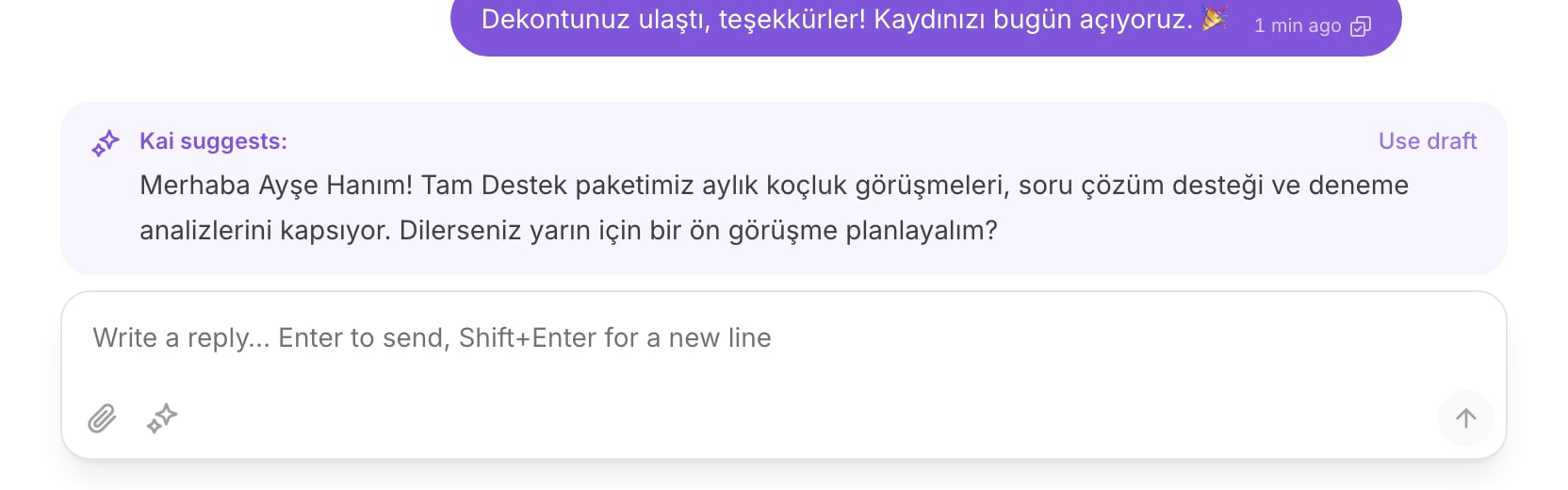 Select **Use draft** to load the text into the composer. Change what you want,
then send. Your team keeps full control of the words that reach the customer.
Watch the Overview page for the first week. **Draft acceptance** tells you how
often your team sends a draft with few changes. That number is the signal that
decides the next step.
**What good looks like:** your team sends most drafts with small edits. If they
rewrite most drafts, go back to the review queue rather than to the settings.
**Time:** the first draft arrives minutes after the first customer message.
After about two weeks of copilot, pick one source that your team almost never
corrects. Open its channel card in **Settings → Channels**, and set that source
to **Autopilot** under **Per-source modes**. Leave the rest on **Inherit**.
Keep the scope on **Anything a reviewer approved** at first, or use **Only the
intents I pick** for a narrower start. Then widen it as the numbers hold.
The full detail is in [Copilot, autopilot and off](/product/modes).
## Next
What happens to one live message, and what a Brain version means.
The modes in depth, and a safe ramp.
Select **Use draft** to load the text into the composer. Change what you want,
then send. Your team keeps full control of the words that reach the customer.
Watch the Overview page for the first week. **Draft acceptance** tells you how
often your team sends a draft with few changes. That number is the signal that
decides the next step.
**What good looks like:** your team sends most drafts with small edits. If they
rewrite most drafts, go back to the review queue rather than to the settings.
**Time:** the first draft arrives minutes after the first customer message.
After about two weeks of copilot, pick one source that your team almost never
corrects. Open its channel card in **Settings → Channels**, and set that source
to **Autopilot** under **Per-source modes**. Leave the rest on **Inherit**.
Keep the scope on **Anything a reviewer approved** at first, or use **Only the
intents I pick** for a narrower start. Then widen it as the numbers hold.
The full detail is in [Copilot, autopilot and off](/product/modes).
## Next
What happens to one live message, and what a Brain version means.
The modes in depth, and a safe ramp.