> ## Documentation Index
> Fetch the complete documentation index at: https://docs.kaisupport.com/llms.txt
> Use this file to discover all available pages before exploring further.
# The overview page
> Read every card on the Overview page, and know what to do when a number is wrong.
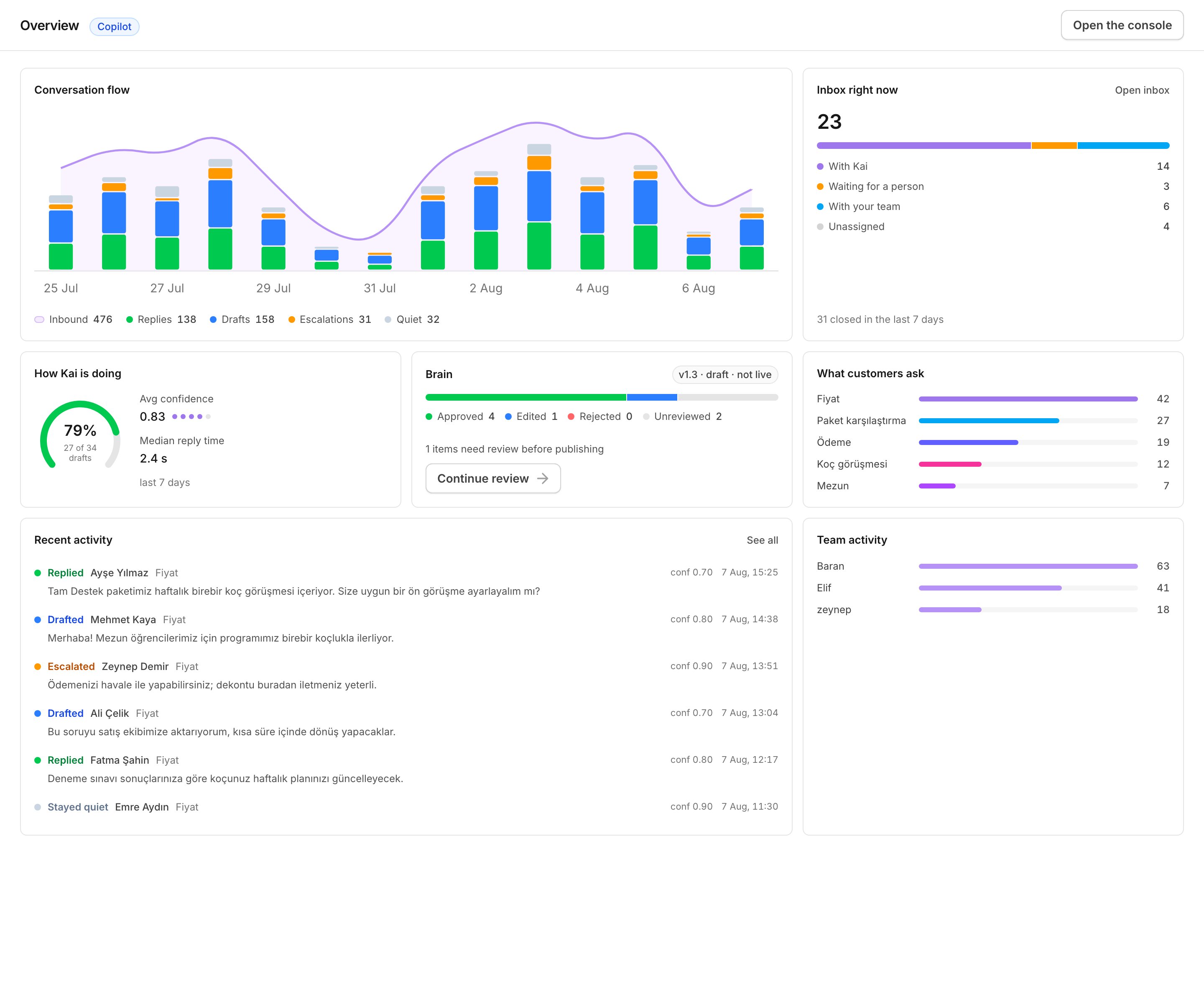
**Overview** is the first screen of the workspace. Its reading order is a
manager's morning: how much came in and what Kai did with it, what the inbox
holds right now, whether Kai is any good, what still blocks publishing, and
what just happened.
 ## The header
Beside the page name is one chip: **Autopilot**, **Copilot** or **Off**. Hold
the pointer on it to read what it means for your customers. If no channel is
connected, the header says instead: *No channel is connected yet, so Kai is
not talking to anyone.*
The chip shows the mode of your channels. Mode is set per channel and can be
overridden per source. See [Copilot and autopilot](/product/modes).
## Conversation flow
## The header
Beside the page name is one chip: **Autopilot**, **Copilot** or **Off**. Hold
the pointer on it to read what it means for your customers. If no channel is
connected, the header says instead: *No channel is connected yet, so Kai is
not talking to anyone.*
The chip shows the mode of your channels. Mode is set per channel and can be
overridden per source. See [Copilot and autopilot](/product/modes).
## Conversation flow
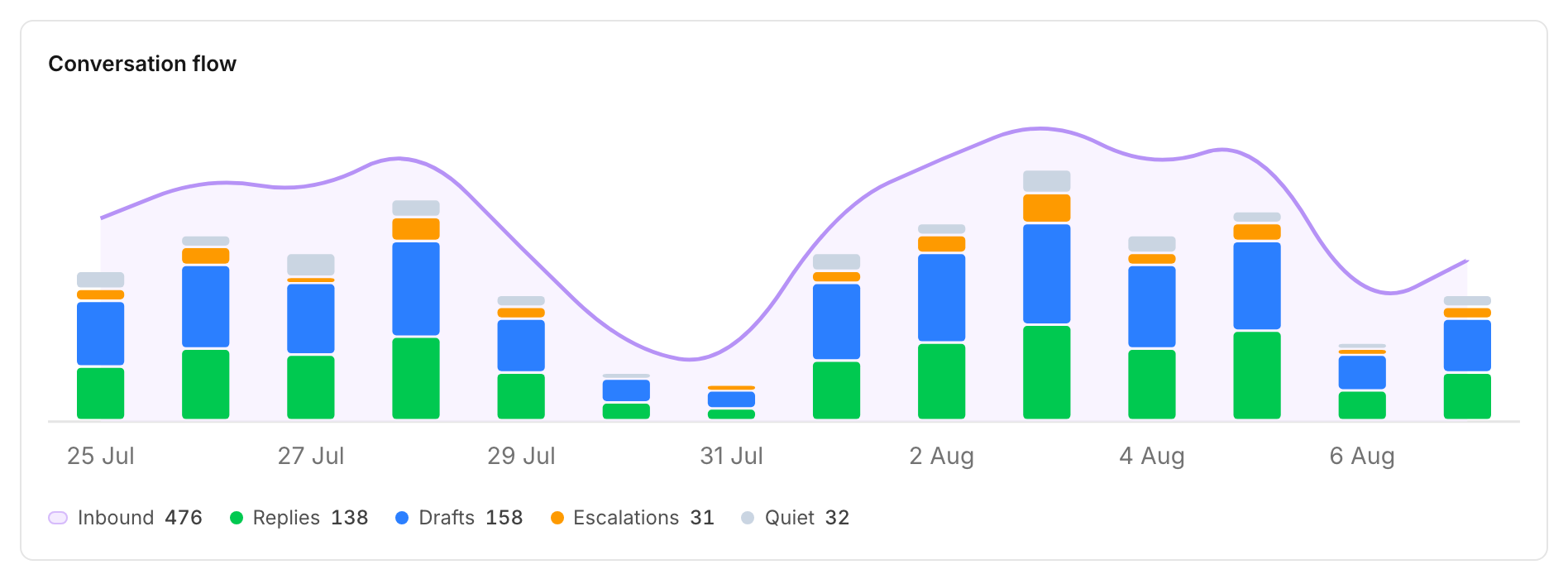 Inbound messages, and what Kai did with them, per day, over two weeks. The
legend counts the whole period: **Inbound**, **Replies**, **Drafts**,
**Escalations**, **Quiet**.
**Healthy:** the action bars track the inbound bar. Their mix matches your
mode. In copilot, almost everything is a draft. In autopilot, replies lead and
escalations are a small share.
**When it is wrong:**
| What you see | What to do |
| ------------------------------------- | -------------------------------------------------------------------------------------------------------------------- |
| Inbound with almost no actions | Check the channel. An **Off** channel receives and records, but does not act. |
| Escalations near the level of replies | Read them in [Activity](#the-activity-page). Too many handoff rules, or rules that are too wide, is the usual cause. |
| Drafts in autopilot | Normal, and it is the point. Read why in Activity: an ungrounded number and an unreviewed answer both draft. |
| The card is empty | *No traffic in the last two weeks.* Connect a channel and it fills up. |
## Inbox right now
Inbound messages, and what Kai did with them, per day, over two weeks. The
legend counts the whole period: **Inbound**, **Replies**, **Drafts**,
**Escalations**, **Quiet**.
**Healthy:** the action bars track the inbound bar. Their mix matches your
mode. In copilot, almost everything is a draft. In autopilot, replies lead and
escalations are a small share.
**When it is wrong:**
| What you see | What to do |
| ------------------------------------- | -------------------------------------------------------------------------------------------------------------------- |
| Inbound with almost no actions | Check the channel. An **Off** channel receives and records, but does not act. |
| Escalations near the level of replies | Read them in [Activity](#the-activity-page). Too many handoff rules, or rules that are too wide, is the usual cause. |
| Drafts in autopilot | Normal, and it is the point. Read why in Activity: an ungrounded number and an unreviewed answer both draft. |
| The card is empty | *No traffic in the last two weeks.* Connect a channel and it fills up. |
## Inbox right now
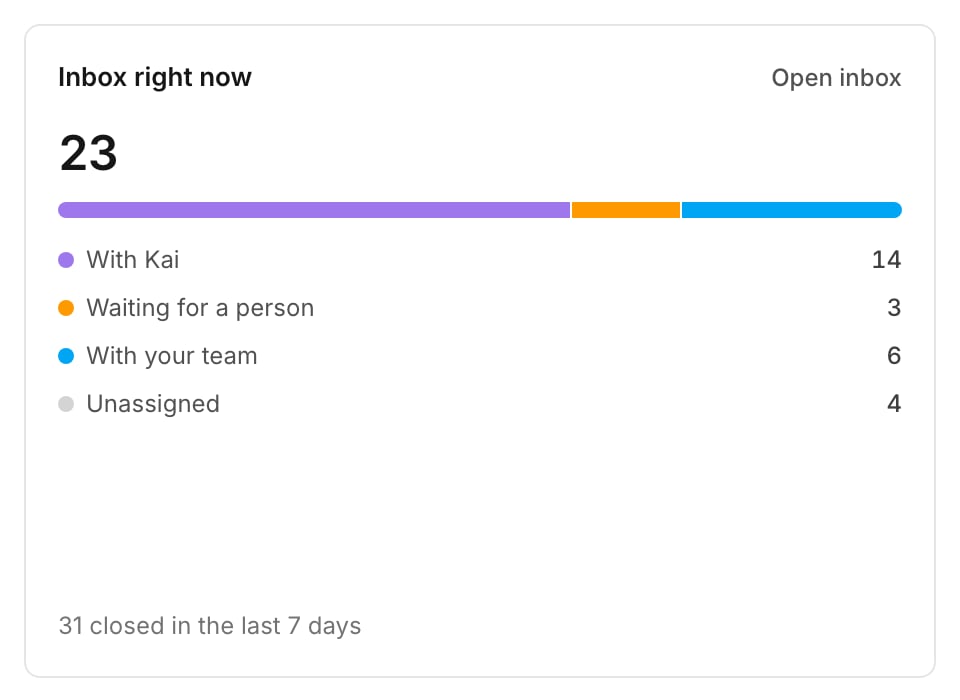 A count of open conversations, and who holds them.
| Segment | Meaning |
| ------------------------ | -------------------------------------------------- |
| **With Kai** | Kai is handling it, and no person has taken over. |
| **Waiting for a person** | Kai handed it over, or drafted. Somebody must act. |
| **With your team** | A teammate is on it. |
| **Unassigned** | Nobody holds it yet. |
Under the card: how many conversations closed in the last 7 days.
**Healthy:** **Waiting for a person** and **Unassigned** are small and they
move. They are queues, not stock.
**When it is wrong:** a growing **Unassigned** count means work reaches nobody.
Give those customers an account owner, so the next conversation routes by
itself. See [Contacts and account owners](/product/contacts).
## How Kai is doing
A count of open conversations, and who holds them.
| Segment | Meaning |
| ------------------------ | -------------------------------------------------- |
| **With Kai** | Kai is handling it, and no person has taken over. |
| **Waiting for a person** | Kai handed it over, or drafted. Somebody must act. |
| **With your team** | A teammate is on it. |
| **Unassigned** | Nobody holds it yet. |
Under the card: how many conversations closed in the last 7 days.
**Healthy:** **Waiting for a person** and **Unassigned** are small and they
move. They are queues, not stock.
**When it is wrong:** a growing **Unassigned** count means work reaches nobody.
Give those customers an account owner, so the next conversation routes by
itself. See [Contacts and account owners](/product/contacts).
## How Kai is doing
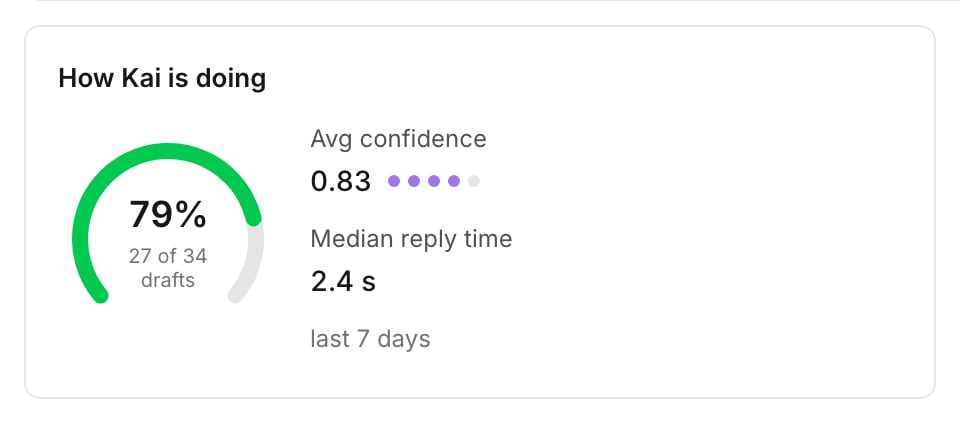 Three numbers, over the last 7 days.
### Draft acceptance
The share of Kai's drafts that your team accepted, shown as a gauge, with
the count under it, for example *27 of 34 drafts*.
**Healthy:** 60% or more. That is the number that says copilot is worth the
click.
**When it is low:** the drafts are wrong, not the team. Open
[Review](/product/console) in the console, correct ten replies in the weakest
topic, then [retrain](/product/retrain).
**When it reads a dash:** no feedback yet. Kai fills this card from what your
team did with each draft, so it stays empty until Kai has written drafts and
your team has acted on them. Ratings are a separate signal, and they are what
let a live reply into the next training corpus.
### Avg confidence
The average confidence of Kai's actions, from 0 to 1.
**Healthy:** comfortably above the confidence floor you set on the channel.
Kai drafts instead of sending when an action falls under that floor.
**When it is low:** the questions arriving are not the questions the Brain was
compiled from. Read **What customers ask** below. A topic with high demand and
no answer entry is the gap.
### Median reply time
How long Kai took to produce its action.
**Healthy:** a few seconds. Kai waits on purpose before it answers, so that a
customer who writes five short messages gets one reply, not five. That wait is
set per channel and is not counted here.
**When it is high:** the model is slow or the conversation is long. It is not
a Brain problem.
## Brain
Three numbers, over the last 7 days.
### Draft acceptance
The share of Kai's drafts that your team accepted, shown as a gauge, with
the count under it, for example *27 of 34 drafts*.
**Healthy:** 60% or more. That is the number that says copilot is worth the
click.
**When it is low:** the drafts are wrong, not the team. Open
[Review](/product/console) in the console, correct ten replies in the weakest
topic, then [retrain](/product/retrain).
**When it reads a dash:** no feedback yet. Kai fills this card from what your
team did with each draft, so it stays empty until Kai has written drafts and
your team has acted on them. Ratings are a separate signal, and they are what
let a live reply into the next training corpus.
### Avg confidence
The average confidence of Kai's actions, from 0 to 1.
**Healthy:** comfortably above the confidence floor you set on the channel.
Kai drafts instead of sending when an action falls under that floor.
**When it is low:** the questions arriving are not the questions the Brain was
compiled from. Read **What customers ask** below. A topic with high demand and
no answer entry is the gap.
### Median reply time
How long Kai took to produce its action.
**Healthy:** a few seconds. Kai waits on purpose before it answers, so that a
customer who writes five short messages gets one reply, not five. That wait is
set per channel and is not counted here.
**When it is high:** the model is slow or the conversation is long. It is not
a Brain problem.
## Brain
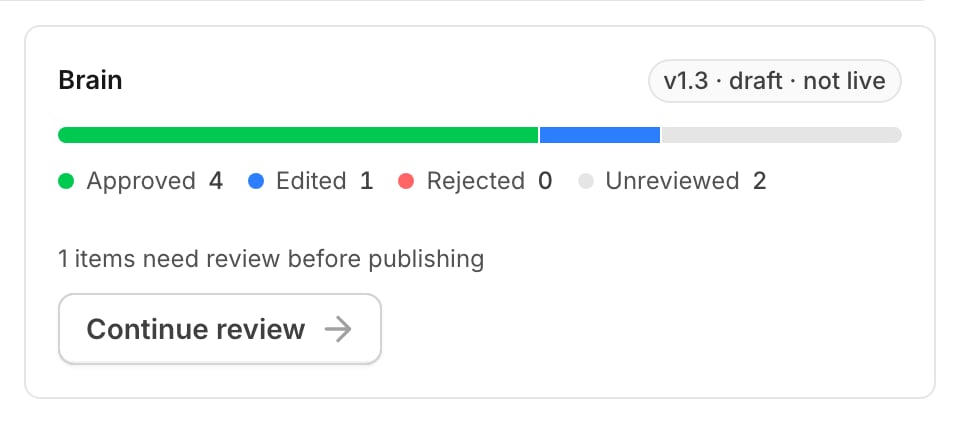 The version and its state, then a band of every item in it: **Approved**,
**Edited**, **Rejected**, **Unreviewed**.
Under the band is the one thing to do next:
* *This draft is ready to publish*, with **Review and publish**;
* a count of the items that need review before publishing, with
**Continue review**.
**Healthy:** one published version serving, and, while you work, one draft
beside it.
**What blocks publishing** is narrower than "everything approved". Only what
could reach a customer unsupervised must be reviewed: your brand voice, every
human handoff rule, every conversation flow that autopilot may use, and the
answers those flows use. Unreviewed content is allowed into a published Brain.
It only drafts.
A published version cannot be edited. Use **Edit as a new draft** to open a
copy. The published version keeps serving until you publish the new one. See
[Review and publish](/product/review-and-publish).
## What customers ask
The topics Kai classified in live traffic, largest first.
**Healthy:** the top topics match the answers you reviewed first.
**When it is wrong:** a large topic that your answer library does not cover is
the highest value work you have. Ask about it in the console, then retrain
with that goal.
The card is empty until Kai classifies live traffic. It is not filled from your
import.
## Recent activity
The version and its state, then a band of every item in it: **Approved**,
**Edited**, **Rejected**, **Unreviewed**.
Under the band is the one thing to do next:
* *This draft is ready to publish*, with **Review and publish**;
* a count of the items that need review before publishing, with
**Continue review**.
**Healthy:** one published version serving, and, while you work, one draft
beside it.
**What blocks publishing** is narrower than "everything approved". Only what
could reach a customer unsupervised must be reviewed: your brand voice, every
human handoff rule, every conversation flow that autopilot may use, and the
answers those flows use. Unreviewed content is allowed into a published Brain.
It only drafts.
A published version cannot be edited. Use **Edit as a new draft** to open a
copy. The published version keeps serving until you publish the new one. See
[Review and publish](/product/review-and-publish).
## What customers ask
The topics Kai classified in live traffic, largest first.
**Healthy:** the top topics match the answers you reviewed first.
**When it is wrong:** a large topic that your answer library does not cover is
the highest value work you have. Ask about it in the console, then retrain
with that goal.
The card is empty until Kai classifies live traffic. It is not filled from your
import.
## Recent activity
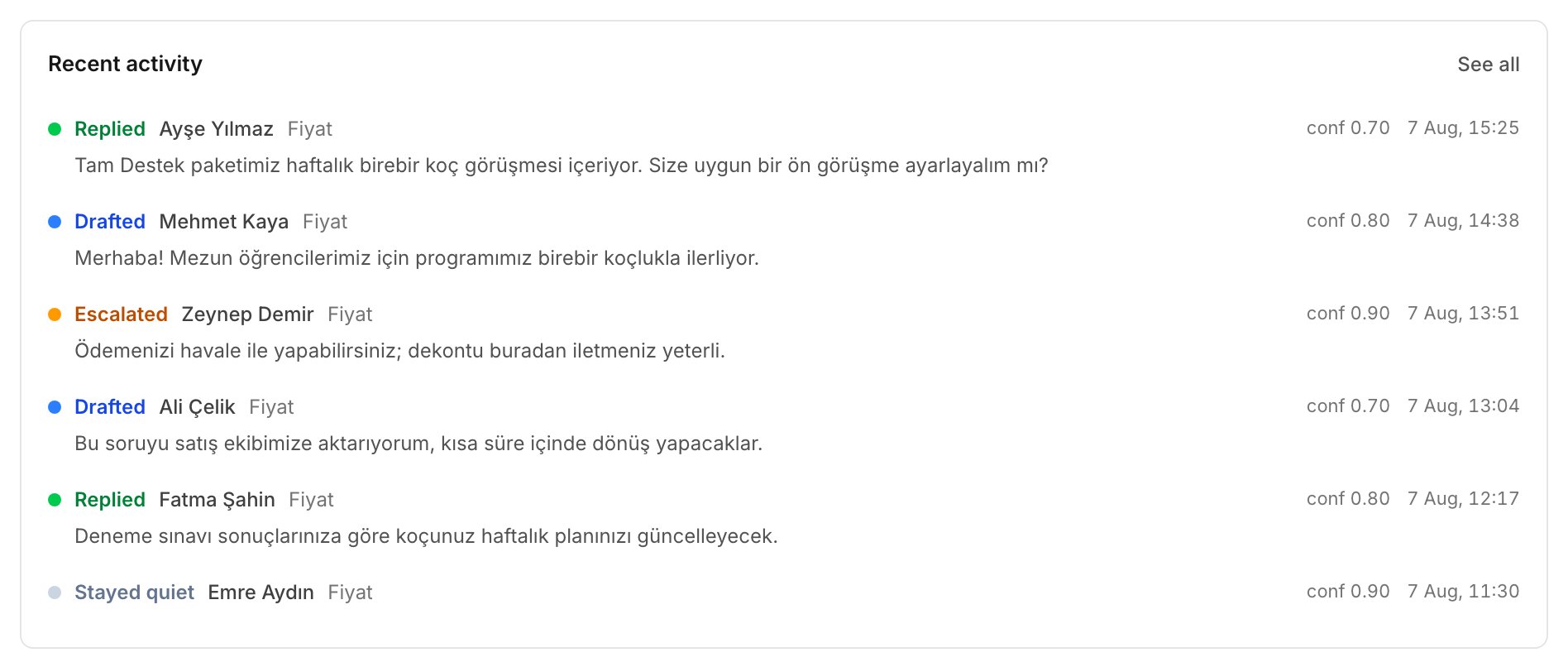 The last actions, one line each: **Replied**, **Drafted**, **Escalated** or
**Stayed quiet**, the customer, the topics, the confidence and the time. An
escalation carries its handoff summary, and a quiet action its reason, so no
row is only a dot and a clock.
Select a row to open the conversation. Select **See all** for the full feed.
## Team activity
How many replies each teammate sent from the inbox, over the same 7 days.
This is a workload view, not a ranking. Use it to find the person who is
carrying the queue alone, and the queue that nobody is carrying.
The card stays empty until your team replies from the Kai inbox.
## The Activity page
**Activity** holds every action, with the reasoning that produced it: *What Kai
did, and why. Every action carries the playbook, answer entries and guardrails
behind it.*
Filter with **Everything**, **Replied**, **Drafted**, **Escalated** and
**Stayed quiet**. The header repeats draft acceptance over 7 days.
Open one action, and you get:
* the transcript of the conversation;
* **Kai's reasoning**: the conversation flow, the answer entries used, the
grounded facts, the confidence, and the Brain version;
* the **Coaching note** that went with a draft, or the **Handoff context** that
went with an escalation;
* **Autopilot muted: a human took over**, when somebody replied on the thread.
Use this page when a customer complains about an answer. It tells you which
entry produced it, and that entry is the thing to fix.
The feed fills as Kai acts. Until a channel is connected, it says: *Kai
records every action the moment it takes one. Connect a channel and this
fills up.*
## Next
Ask the Brain, propose a change, test a reply, review what Kai said.
Turn corrections and live conversations into a new draft.
The last actions, one line each: **Replied**, **Drafted**, **Escalated** or
**Stayed quiet**, the customer, the topics, the confidence and the time. An
escalation carries its handoff summary, and a quiet action its reason, so no
row is only a dot and a clock.
Select a row to open the conversation. Select **See all** for the full feed.
## Team activity
How many replies each teammate sent from the inbox, over the same 7 days.
This is a workload view, not a ranking. Use it to find the person who is
carrying the queue alone, and the queue that nobody is carrying.
The card stays empty until your team replies from the Kai inbox.
## The Activity page
**Activity** holds every action, with the reasoning that produced it: *What Kai
did, and why. Every action carries the playbook, answer entries and guardrails
behind it.*
Filter with **Everything**, **Replied**, **Drafted**, **Escalated** and
**Stayed quiet**. The header repeats draft acceptance over 7 days.
Open one action, and you get:
* the transcript of the conversation;
* **Kai's reasoning**: the conversation flow, the answer entries used, the
grounded facts, the confidence, and the Brain version;
* the **Coaching note** that went with a draft, or the **Handoff context** that
went with an escalation;
* **Autopilot muted: a human took over**, when somebody replied on the thread.
Use this page when a customer complains about an answer. It tells you which
entry produced it, and that entry is the thing to fix.
The feed fills as Kai acts. Until a channel is connected, it says: *Kai
records every action the moment it takes one. Connect a channel and this
fills up.*
## Next
Ask the Brain, propose a change, test a reply, review what Kai said.
Turn corrections and live conversations into a new draft.