> ## Documentation Index
> Fetch the complete documentation index at: https://docs.kaisupport.com/llms.txt
> Use this file to discover all available pages before exploring further.
# Channels
> Connect Intercom or WhatsApp Cloud, set a mode per source, and keep WhatsApp templates in order.
A channel is one connection between Kai and a place your customers write. Kai
speaks Intercom and WhatsApp Cloud today. One Brain answers on all of them.
Open **Settings → Channels**. Each connected channel is one row. The row says
which channel it is, which mode it runs, and whether it is live.
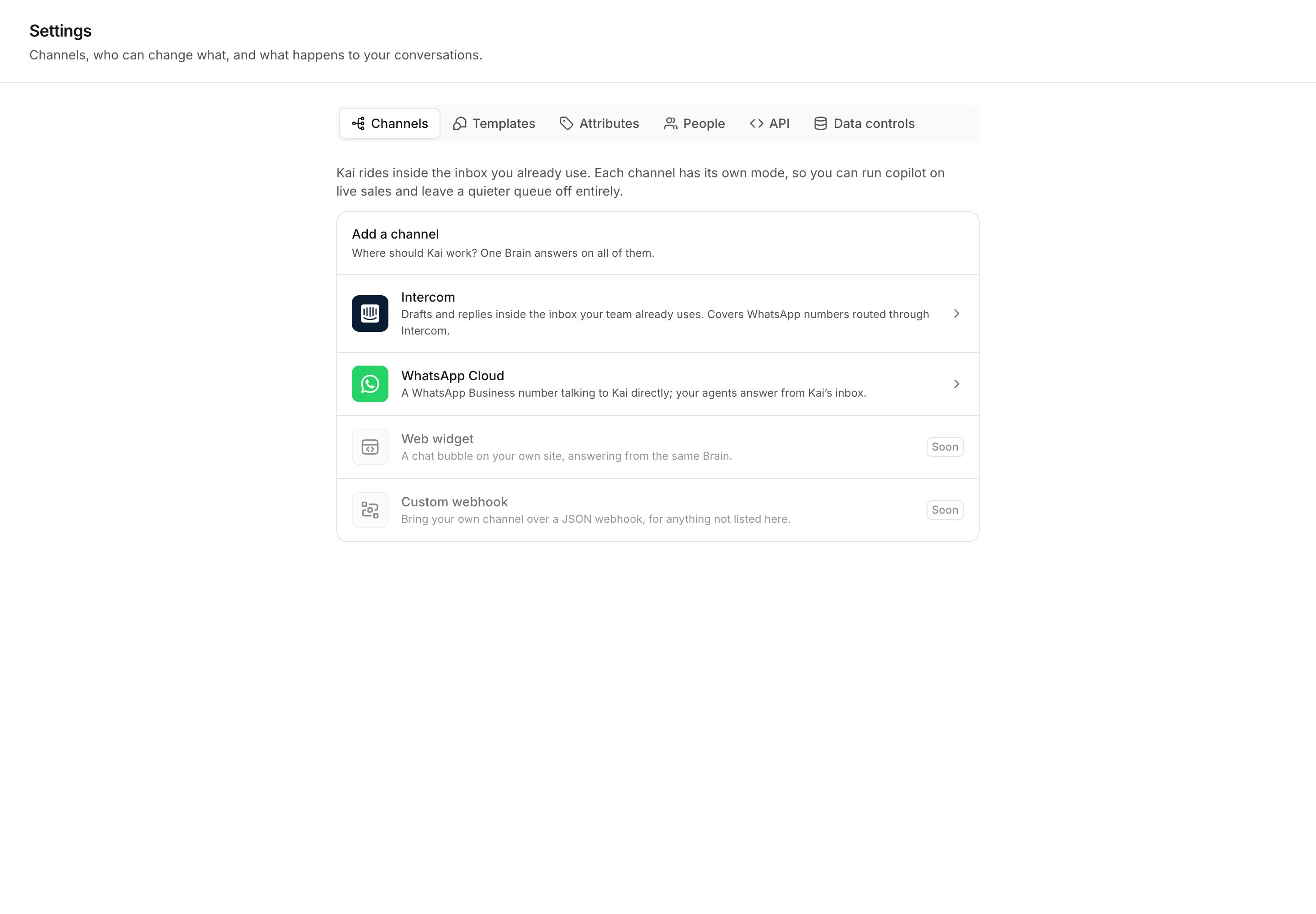
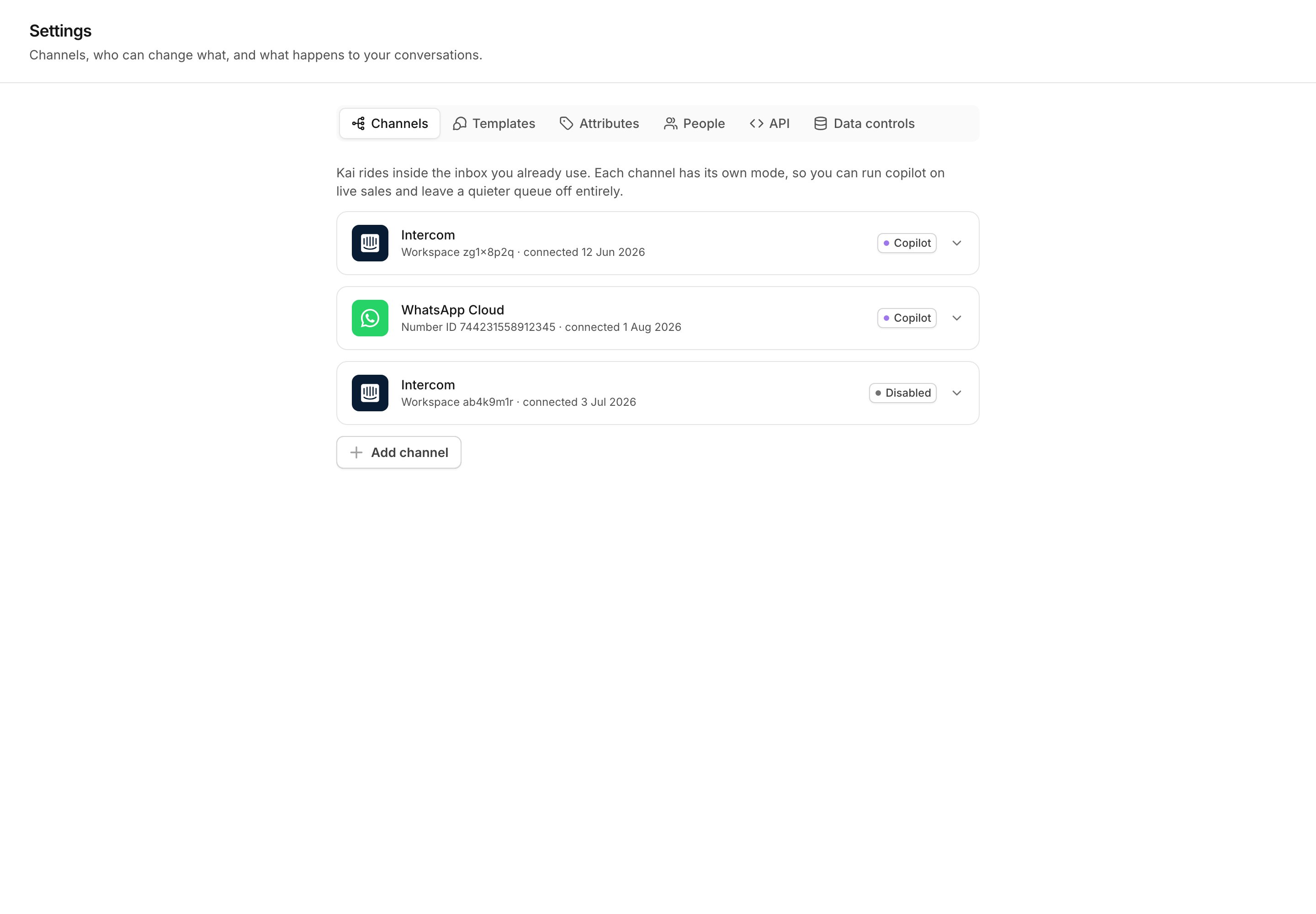 If nothing is connected yet, the page says so and offers **Add channel**. Only
an owner or an admin can add one.
If nothing is connected yet, the page says so and offers **Add channel**. Only
an owner or an admin can add one.
 ## Connect Intercom
Kai works inside the inbox your team already uses. Kai writes drafts as
internal notes and hands a conversation over by assigning it.
In Intercom, open **Developer Hub → your app → Configure →
Authentication**. Copy the access token. The token is scoped to one
workspace, so Kai learns the workspace from the token.
In the same app, open **Basic Info** and copy the client secret. It is
optional in Intercom's own token flow, so Kai treats it as optional too.
Read [Which secret to use](#which-secret-to-use) before you skip it.
In **Settings → Channels**, select **Add channel**, then **Intercom**.
Paste the access token, and the client secret if you have one. Select
**Connect**. Kai checks the token with Intercom before it stores anything.
Kai shows a URL after it connects. In Intercom, open **Developer Hub →
your app → Webhooks** and add that URL.
Subscribe to `conversation.user.created`,
`conversation.user.replied`, `conversation.admin.replied` and
`conversation.admin.closed`. Kai needs the admin replies to know that a
human took over.
Kai stores the token encrypted on your own server. To rotate a token, or to
add a client secret later, run the connect flow again with the new values.
### Which secret to use
Kai has two ways to prove that a delivery is genuine.
| What you give Kai | How Kai checks a delivery |
| ------------------------------ | ----------------------------------------------------- |
| Access token and client secret | Kai verifies the signature on each delivery body. |
| Access token only | Kai puts a secret in the webhook URL and checks that. |
The signature is the stronger of the two, because it authenticates the message
and not only the caller. A URL reaches a log file more easily than a header
does.
If your webhook URL holds a secret, treat the URL like a password. Add the
client secret and connect again to move to signature checks.
## Connect WhatsApp Cloud
A WhatsApp Business number talks to Kai directly. There is no provider inbox,
so your team answers from [Kai's inbox](/product/inbox).
Open **Meta App Dashboard → WhatsApp → API Setup**. Copy the **Access
token**, the **Phone number ID** and the **WhatsApp Business Account ID**.
Use a permanent system-user token, not the 24-hour test token.
Open the app's **Basic Settings** and copy the app secret. With it, Kai
verifies the signature on each delivery. Without it, the secret webhook
URL authenticates the caller instead.
In **Settings → Channels**, select **Add channel**, then **WhatsApp
Cloud**. Paste the values and select **Connect**. Kai checks them against
Meta before it stores anything.
Kai registers the number for Cloud API and subscribes the webhook fields
to its own callback URL. The result page lists each step and says which
ones are done.
If Kai could not subscribe the webhook, it shows the **Callback URL** and
the **Verify token**. In Meta, open **App Dashboard → WhatsApp →
Configuration → Webhook**, paste both, then subscribe the `messages`
field.
The callback URL contains the verify token. Treat that URL like a password.
A WhatsApp channel card holds a **Delivery setup** panel. It shows each step
that must hold for a message to arrive: number ownership, registration, the
`messages` subscription, the callback URL, and the app subscription. If
messages stop arriving while the credentials are still valid, read that panel
first.
## Sources inside one channel
One Intercom workspace carries several surfaces on one credential and one
webhook. Intercom calls each of them a **source**. Kai knows Messenger,
WhatsApp, Email, SMS, Instagram, Facebook and Phone.
Those surfaces are not one audience. A Messenger visitor is often anonymous. A
WhatsApp thread is a phone number that already chose to write to you. Most
teams trust the two differently.
So each source can carry its own mode. Open the channel card and find
**Per-source modes**. Each source offers **Inherit**, **Copilot**,
**Autopilot** and **Off**. **Inherit** is the resting state, and it follows the
mode set on the channel above.
## Connect Intercom
Kai works inside the inbox your team already uses. Kai writes drafts as
internal notes and hands a conversation over by assigning it.
In Intercom, open **Developer Hub → your app → Configure →
Authentication**. Copy the access token. The token is scoped to one
workspace, so Kai learns the workspace from the token.
In the same app, open **Basic Info** and copy the client secret. It is
optional in Intercom's own token flow, so Kai treats it as optional too.
Read [Which secret to use](#which-secret-to-use) before you skip it.
In **Settings → Channels**, select **Add channel**, then **Intercom**.
Paste the access token, and the client secret if you have one. Select
**Connect**. Kai checks the token with Intercom before it stores anything.
Kai shows a URL after it connects. In Intercom, open **Developer Hub →
your app → Webhooks** and add that URL.
Subscribe to `conversation.user.created`,
`conversation.user.replied`, `conversation.admin.replied` and
`conversation.admin.closed`. Kai needs the admin replies to know that a
human took over.
Kai stores the token encrypted on your own server. To rotate a token, or to
add a client secret later, run the connect flow again with the new values.
### Which secret to use
Kai has two ways to prove that a delivery is genuine.
| What you give Kai | How Kai checks a delivery |
| ------------------------------ | ----------------------------------------------------- |
| Access token and client secret | Kai verifies the signature on each delivery body. |
| Access token only | Kai puts a secret in the webhook URL and checks that. |
The signature is the stronger of the two, because it authenticates the message
and not only the caller. A URL reaches a log file more easily than a header
does.
If your webhook URL holds a secret, treat the URL like a password. Add the
client secret and connect again to move to signature checks.
## Connect WhatsApp Cloud
A WhatsApp Business number talks to Kai directly. There is no provider inbox,
so your team answers from [Kai's inbox](/product/inbox).
Open **Meta App Dashboard → WhatsApp → API Setup**. Copy the **Access
token**, the **Phone number ID** and the **WhatsApp Business Account ID**.
Use a permanent system-user token, not the 24-hour test token.
Open the app's **Basic Settings** and copy the app secret. With it, Kai
verifies the signature on each delivery. Without it, the secret webhook
URL authenticates the caller instead.
In **Settings → Channels**, select **Add channel**, then **WhatsApp
Cloud**. Paste the values and select **Connect**. Kai checks them against
Meta before it stores anything.
Kai registers the number for Cloud API and subscribes the webhook fields
to its own callback URL. The result page lists each step and says which
ones are done.
If Kai could not subscribe the webhook, it shows the **Callback URL** and
the **Verify token**. In Meta, open **App Dashboard → WhatsApp →
Configuration → Webhook**, paste both, then subscribe the `messages`
field.
The callback URL contains the verify token. Treat that URL like a password.
A WhatsApp channel card holds a **Delivery setup** panel. It shows each step
that must hold for a message to arrive: number ownership, registration, the
`messages` subscription, the callback URL, and the app subscription. If
messages stop arriving while the credentials are still valid, read that panel
first.
## Sources inside one channel
One Intercom workspace carries several surfaces on one credential and one
webhook. Intercom calls each of them a **source**. Kai knows Messenger,
WhatsApp, Email, SMS, Instagram, Facebook and Phone.
Those surfaces are not one audience. A Messenger visitor is often anonymous. A
WhatsApp thread is a phone number that already chose to write to you. Most
teams trust the two differently.
So each source can carry its own mode. Open the channel card and find
**Per-source modes**. Each source offers **Inherit**, **Copilot**,
**Autopilot** and **Off**. **Inherit** is the resting state, and it follows the
mode set on the channel above.
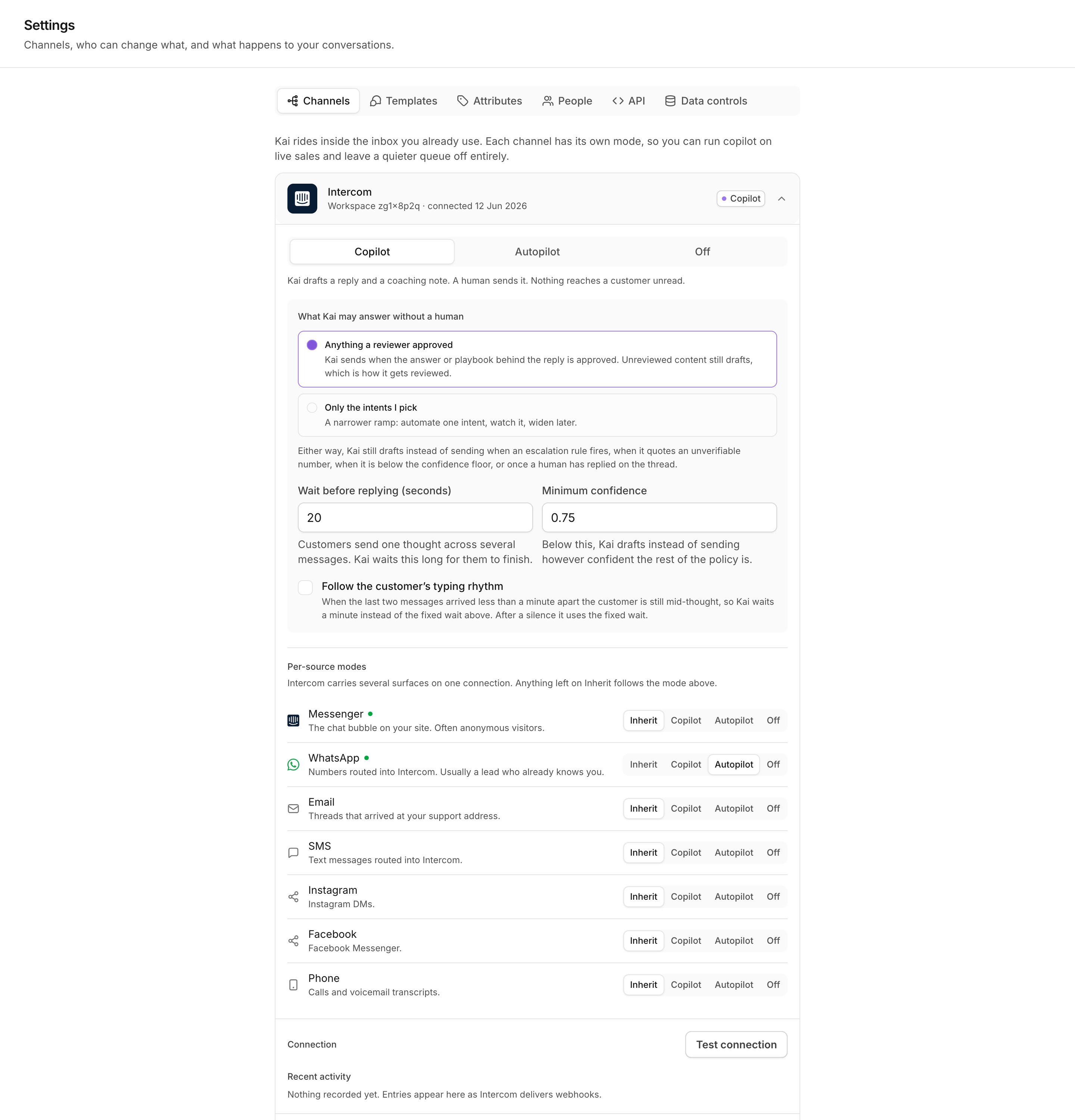 A green dot beside a source means Kai has seen traffic on it. A source that
Intercom adds later still works: it inherits the channel mode until you set
one.
Move one source to autopilot first, not the whole channel. See
[Copilot, autopilot and off](/product/modes).
## Test connection
An Intercom card has a **Test connection** button. It asks Intercom whether
the stored credential still works, and names the workspace when it does. Use it
when a channel goes quiet, before you change any policy.
A WhatsApp card has no single button, because a WhatsApp connection is four
steps that break on their own. The **Delivery setup** panel checks each one.
## Recent activity
Every channel card holds a **Recent activity** list. It records what arrived
and what Kai refused: deliveries, rejections, subscriptions, archives, and the
account notices Meta pushes about a WhatsApp Business Account.
Read it when a channel looks connected but nothing happens. An account notice,
such as a quality drop or a template decision, stops delivery while the
credentials stay perfectly valid.
## Disable a channel
Select **Disable channel** in the card footer. Kai stops acting on that
connection. Nothing changes in Intercom or in Meta.
Two more actions appear only on a disabled channel:
* **Archive conversations** files the remaining threads as history. They stay
readable and searchable in Kai, and they accept no new reply. Nothing is sent
to the provider.
* **Delete channel** removes the connection and every conversation, message and
template that Kai holds from it. The provider itself is untouched.
Deleting a channel cannot be undone.
## Message templates
WhatsApp closes a conversation 24 hours after the customer's last message.
After that, a free-form message fails. To write first, or to write late, you
must send a template that Meta approved.
Meta owns the template library. Kai mirrors it. Open **Settings → Templates**.
A green dot beside a source means Kai has seen traffic on it. A source that
Intercom adds later still works: it inherits the channel mode until you set
one.
Move one source to autopilot first, not the whole channel. See
[Copilot, autopilot and off](/product/modes).
## Test connection
An Intercom card has a **Test connection** button. It asks Intercom whether
the stored credential still works, and names the workspace when it does. Use it
when a channel goes quiet, before you change any policy.
A WhatsApp card has no single button, because a WhatsApp connection is four
steps that break on their own. The **Delivery setup** panel checks each one.
## Recent activity
Every channel card holds a **Recent activity** list. It records what arrived
and what Kai refused: deliveries, rejections, subscriptions, archives, and the
account notices Meta pushes about a WhatsApp Business Account.
Read it when a channel looks connected but nothing happens. An account notice,
such as a quality drop or a template decision, stops delivery while the
credentials stay perfectly valid.
## Disable a channel
Select **Disable channel** in the card footer. Kai stops acting on that
connection. Nothing changes in Intercom or in Meta.
Two more actions appear only on a disabled channel:
* **Archive conversations** files the remaining threads as history. They stay
readable and searchable in Kai, and they accept no new reply. Nothing is sent
to the provider.
* **Delete channel** removes the connection and every conversation, message and
template that Kai holds from it. The provider itself is untouched.
Deleting a channel cannot be undone.
## Message templates
WhatsApp closes a conversation 24 hours after the customer's last message.
After that, a free-form message fails. To write first, or to write late, you
must send a template that Meta approved.
Meta owns the template library. Kai mirrors it. Open **Settings → Templates**.
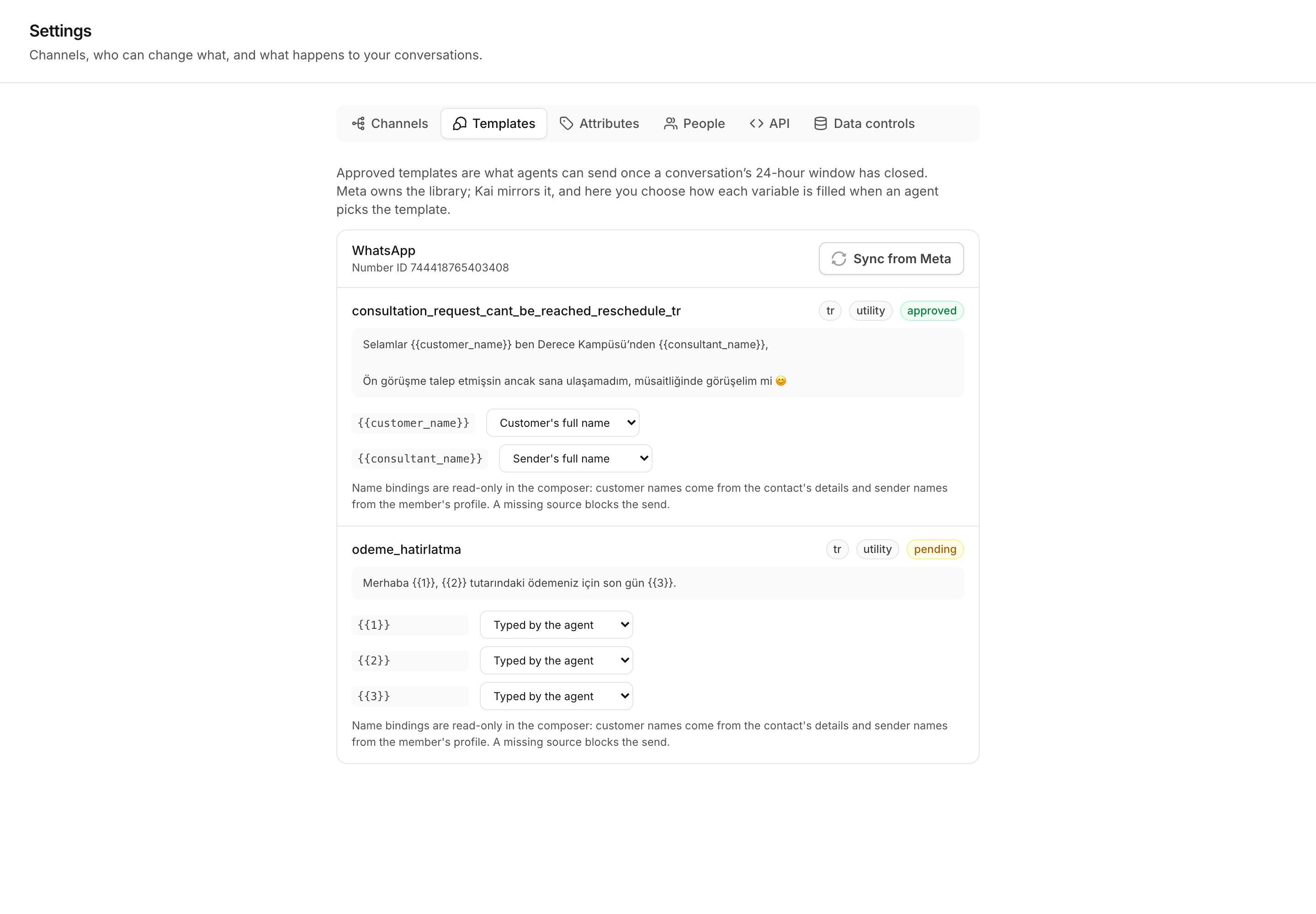 Select **Sync from Meta**. Kai pulls every template this number has, both
approved and not, and reports how many it stored and removed.
A template is approved, pending, rejected, disabled or paused. Only an
approved template can be sent.
For every `{{variable}}` in the body, choose where its value comes from:
typed by the agent, or a name taken from the record. Kai saves each choice
on its own.
Name bindings are read-only in the composer. A customer name comes from the
[contact](/concepts/contacts) details, and a sender name comes from the
teammate's profile. If the source is missing, Kai blocks the send instead of
writing a wrong name.
Kai fills body variables only. A template with variables in its header or its
buttons is not offered to agents, and the row says so.
Only people send outbound messages. A template never changes what Kai does on
its own.
### Direct Send
A WhatsApp channel card holds a **Direct Send** setting. With it, agents write
free-form service messages after the 24-hour window instead of picking a
template. Meta grants this per account. Turn it on only after your account is
in that beta, because elsewhere those sends fail rather than fall back to a
template.
## Next
What each mode does, and what still holds a reply back.
Who may connect a channel and change its policy.
Select **Sync from Meta**. Kai pulls every template this number has, both
approved and not, and reports how many it stored and removed.
A template is approved, pending, rejected, disabled or paused. Only an
approved template can be sent.
For every `{{variable}}` in the body, choose where its value comes from:
typed by the agent, or a name taken from the record. Kai saves each choice
on its own.
Name bindings are read-only in the composer. A customer name comes from the
[contact](/concepts/contacts) details, and a sender name comes from the
teammate's profile. If the source is missing, Kai blocks the send instead of
writing a wrong name.
Kai fills body variables only. A template with variables in its header or its
buttons is not offered to agents, and the row says so.
Only people send outbound messages. A template never changes what Kai does on
its own.
### Direct Send
A WhatsApp channel card holds a **Direct Send** setting. With it, agents write
free-form service messages after the 24-hour window instead of picking a
template. Meta grants this per account. Turn it on only after your account is
in that beta, because elsewhere those sends fail rather than fall back to a
template.
## Next
What each mode does, and what still holds a reply back.
Who may connect a channel and change its policy.