> ## Documentation Index
> Fetch the complete documentation index at: https://docs.kaisupport.com/llms.txt
> Use this file to discover all available pages before exploring further.
# Close and reopen a conversation
> Finish a conversation, find it again, and reply after the WhatsApp 24 hour window closes.
Read this page to close a finished conversation, to find it again, and to know
what to do when a plain reply will not deliver.
## Close a finished conversation
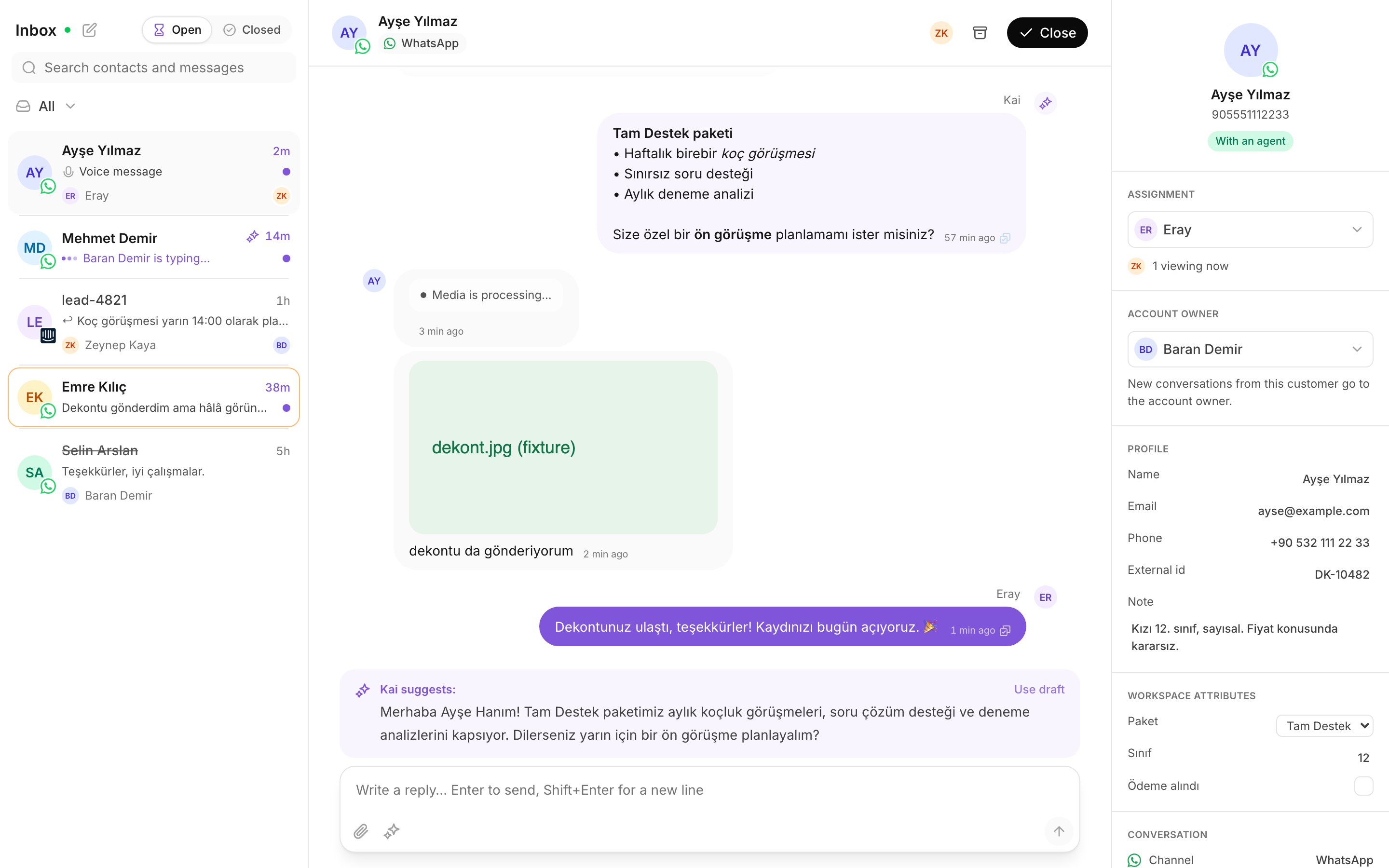
When the customer has their answer, close the conversation.
Kai asks you to confirm. The message says the conversation leaves the open
queue, and that you can reopen it any time.
The conversation leaves **Open**. It is now in **Closed**.
Closing changes one thing: where the conversation sits. It does not delete
anything, it does not tell the customer, and it does not end your relationship
with that person. The messages stay. The customer record stays.
Close often. A queue that only grows tells you nothing about what still needs
work.
 ## How a closed conversation comes back
A closed conversation comes back on its own. When the customer writes again,
the conversation reopens and returns to **Open**.
You can also bring it back yourself:
1. Select **Closed** at the top of the list.
2. Find the conversation. Search works here too, and it ignores the segment.
3. Open it, then select **Reopen**.
Reopening asks for no confirmation. It is the undo of close.
**Archive** is not **Close**. An archived conversation is read only and
permanent. If the customer writes again, the message starts a new
conversation instead of reopening the old one. Use **Close**.
## The WhatsApp 24 hour window
WhatsApp allows a free-form reply only inside 24 hours of the customer's last
message. This is Meta's rule, not a Kai setting, and nobody in your workspace
can turn it off.
The details panel shows the state under **Reply window**: either the time the
window closes, or **Closed**.
Inside the window, write and send as normal.
Outside the window, the composer says:
> The 24-hour WhatsApp window has closed. Only template messages can be sent
> until the customer writes again.
Your message will not deliver. Do not send it again, and do not retype it in
another form. The result is the same.
### What to do instead
The composer changes to the template picker. It offers the templates that
Meta approved for your account.
Pick the one closest to what you wanted to say. Kai fills the variables it
can from your profile and from the customer record.
If your profile has no name, Kai asks you to add it first.
The customer's reply opens a new 24 hour window. The plain composer comes back,
and you can answer normally.
If the picker says no approved templates exist yet, stop and tell your
manager. Templates are added in Settings, which your role does not open.
For the whole composer, and for the delivery ticks beside each message, see
[The inbox](/product/inbox).
## Practice
1. Open a conversation you finished today. Select **Close**, then confirm.
2. Select **Closed** at the top of the list. Find that conversation and select
**Reopen**.
3. Open a WhatsApp conversation and read **Reply window** in the details panel.
Note the time it closes.
## Read next
Use what Kai wrote, change it, or write your own reply.
## How a closed conversation comes back
A closed conversation comes back on its own. When the customer writes again,
the conversation reopens and returns to **Open**.
You can also bring it back yourself:
1. Select **Closed** at the top of the list.
2. Find the conversation. Search works here too, and it ignores the segment.
3. Open it, then select **Reopen**.
Reopening asks for no confirmation. It is the undo of close.
**Archive** is not **Close**. An archived conversation is read only and
permanent. If the customer writes again, the message starts a new
conversation instead of reopening the old one. Use **Close**.
## The WhatsApp 24 hour window
WhatsApp allows a free-form reply only inside 24 hours of the customer's last
message. This is Meta's rule, not a Kai setting, and nobody in your workspace
can turn it off.
The details panel shows the state under **Reply window**: either the time the
window closes, or **Closed**.
Inside the window, write and send as normal.
Outside the window, the composer says:
> The 24-hour WhatsApp window has closed. Only template messages can be sent
> until the customer writes again.
Your message will not deliver. Do not send it again, and do not retype it in
another form. The result is the same.
### What to do instead
The composer changes to the template picker. It offers the templates that
Meta approved for your account.
Pick the one closest to what you wanted to say. Kai fills the variables it
can from your profile and from the customer record.
If your profile has no name, Kai asks you to add it first.
The customer's reply opens a new 24 hour window. The plain composer comes back,
and you can answer normally.
If the picker says no approved templates exist yet, stop and tell your
manager. Templates are added in Settings, which your role does not open.
For the whole composer, and for the delivery ticks beside each message, see
[The inbox](/product/inbox).
## Practice
1. Open a conversation you finished today. Select **Close**, then confirm.
2. Select **Closed** at the top of the list. Find that conversation and select
**Reopen**.
3. Open a WhatsApp conversation and read **Reply window** in the details panel.
Note the time it closes.
## Read next
Use what Kai wrote, change it, or write your own reply.