> ## Documentation Index
> Fetch the complete documentation index at: https://docs.kaisupport.com/llms.txt
> Use this file to discover all available pages before exploring further.
# Kai for support agents
> What Kai does in your inbox, what it never does, and what you decide.
Read this page to learn what changes in your day when Kai works beside you.
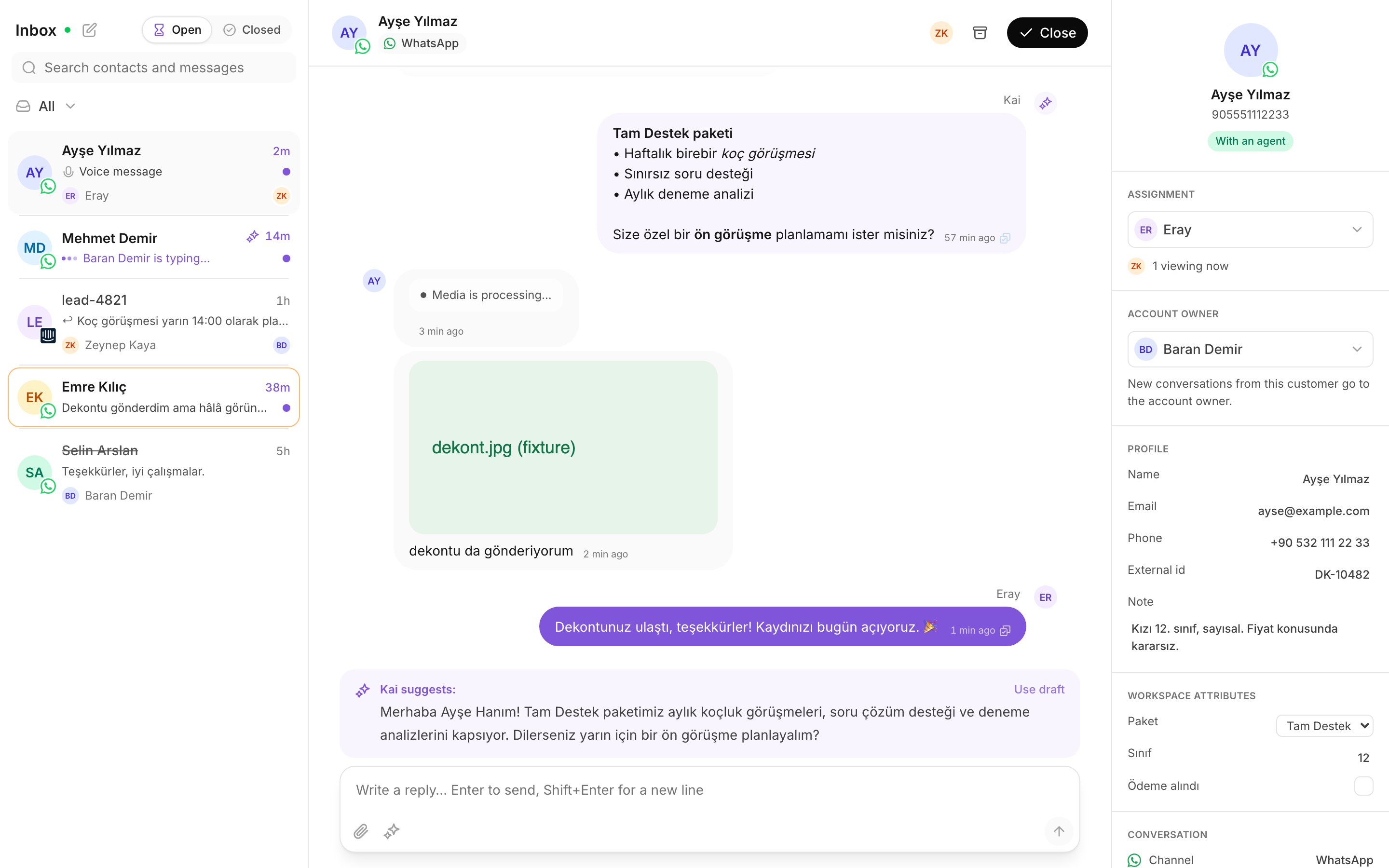 ## What Kai does
Kai reads every message that arrives, on every channel your workspace
connected. Then it does one of two things.
* In **copilot**, Kai writes a draft and puts it above the composer, under
**Kai suggests:**. You read it, you change it, and you send it.
* In **autopilot**, Kai answers the customer by itself. It does this only for
the conversations it is allowed to answer.
Your manager sets the mode for each channel. You do not.
Kai also stops and waits for a person when the answer is not safe to send: a
human handoff rule fires, the reply quotes a number Kai cannot verify, or Kai
is not confident enough. The conversation then waits in **Unassigned**.
## What Kai never does behind you
Kai stops on a conversation the moment a person replies on it. Send one
message, and Kai sends nothing more on that thread.
This holds in copilot and in autopilot. It holds when you reply from Kai, and
when a teammate replies from the channel's own inbox. It is a rule of the
product, not a setting somebody can switch off.
After a takeover, you can still ask for one more suggestion. See
[Send a Kai draft](/product/agent/send-a-kai-draft).
## What you control
Three things are yours:
1. **Which draft you send.** A draft is a suggestion. You can delete it.
2. **What you change in it.** Your edit is what the customer reads.
3. **What that tells Kai.** Kai records whether you sent the draft as it was,
edited it, or ignored it. You send that signal by working, with no extra
step.
A rating is the second signal, and it is the stronger one: Kai never learns
from its own replies unless a person rated them good or wrote a correction.
Your workspace decides who leaves ratings. See
[Rate what Kai writes](/product/agent/rate-what-kai-writes).
## What you cannot change
What Kai says comes from the **Brain**: the answer library, the conversation
flows, and the brand voice that your workspace reviewed. A reviewer decides
that content, not you.
So a wrong answer is **reported, not fixed in place**. Rate it bad, write what
the correct answer is, and the next review picks it up. Do not try to correct
the Brain from the inbox. You cannot, and nobody expects you to.
## Read next
Your queue, the views, unread, and search.
Assignment, presence, and what a handoff looks like.
Finish a conversation, and find it again.
Use a draft, edit it, or write your own.
The rating that teaches the next version.
Get an answer from the Brain, with its sources.
Start with [Find your work](/product/agent/find-your-work).
## What Kai does
Kai reads every message that arrives, on every channel your workspace
connected. Then it does one of two things.
* In **copilot**, Kai writes a draft and puts it above the composer, under
**Kai suggests:**. You read it, you change it, and you send it.
* In **autopilot**, Kai answers the customer by itself. It does this only for
the conversations it is allowed to answer.
Your manager sets the mode for each channel. You do not.
Kai also stops and waits for a person when the answer is not safe to send: a
human handoff rule fires, the reply quotes a number Kai cannot verify, or Kai
is not confident enough. The conversation then waits in **Unassigned**.
## What Kai never does behind you
Kai stops on a conversation the moment a person replies on it. Send one
message, and Kai sends nothing more on that thread.
This holds in copilot and in autopilot. It holds when you reply from Kai, and
when a teammate replies from the channel's own inbox. It is a rule of the
product, not a setting somebody can switch off.
After a takeover, you can still ask for one more suggestion. See
[Send a Kai draft](/product/agent/send-a-kai-draft).
## What you control
Three things are yours:
1. **Which draft you send.** A draft is a suggestion. You can delete it.
2. **What you change in it.** Your edit is what the customer reads.
3. **What that tells Kai.** Kai records whether you sent the draft as it was,
edited it, or ignored it. You send that signal by working, with no extra
step.
A rating is the second signal, and it is the stronger one: Kai never learns
from its own replies unless a person rated them good or wrote a correction.
Your workspace decides who leaves ratings. See
[Rate what Kai writes](/product/agent/rate-what-kai-writes).
## What you cannot change
What Kai says comes from the **Brain**: the answer library, the conversation
flows, and the brand voice that your workspace reviewed. A reviewer decides
that content, not you.
So a wrong answer is **reported, not fixed in place**. Rate it bad, write what
the correct answer is, and the next review picks it up. Do not try to correct
the Brain from the inbox. You cannot, and nobody expects you to.
## Read next
Your queue, the views, unread, and search.
Assignment, presence, and what a handoff looks like.
Finish a conversation, and find it again.
Use a draft, edit it, or write your own.
The rating that teaches the next version.
Get an answer from the Brain, with its sources.
Start with [Find your work](/product/agent/find-your-work).