> ## Documentation Index
> Fetch the complete documentation index at: https://docs.kaisupport.com/llms.txt
> Use this file to discover all available pages before exploring further.
# What Kai is
> Kai reads the conversations your team already handled, and turns them into a support agent that drafts or replies.
Kai turns your team's past chats into a support agent. You upload a chat
export. Kai reads what your team already said to customers, and compiles it
into a **Brain**. Your team reviews the Brain. After that, Kai writes drafts in
your inbox, or answers customers on its own.
You do not write a knowledge base. You already wrote one, one conversation at a
time.
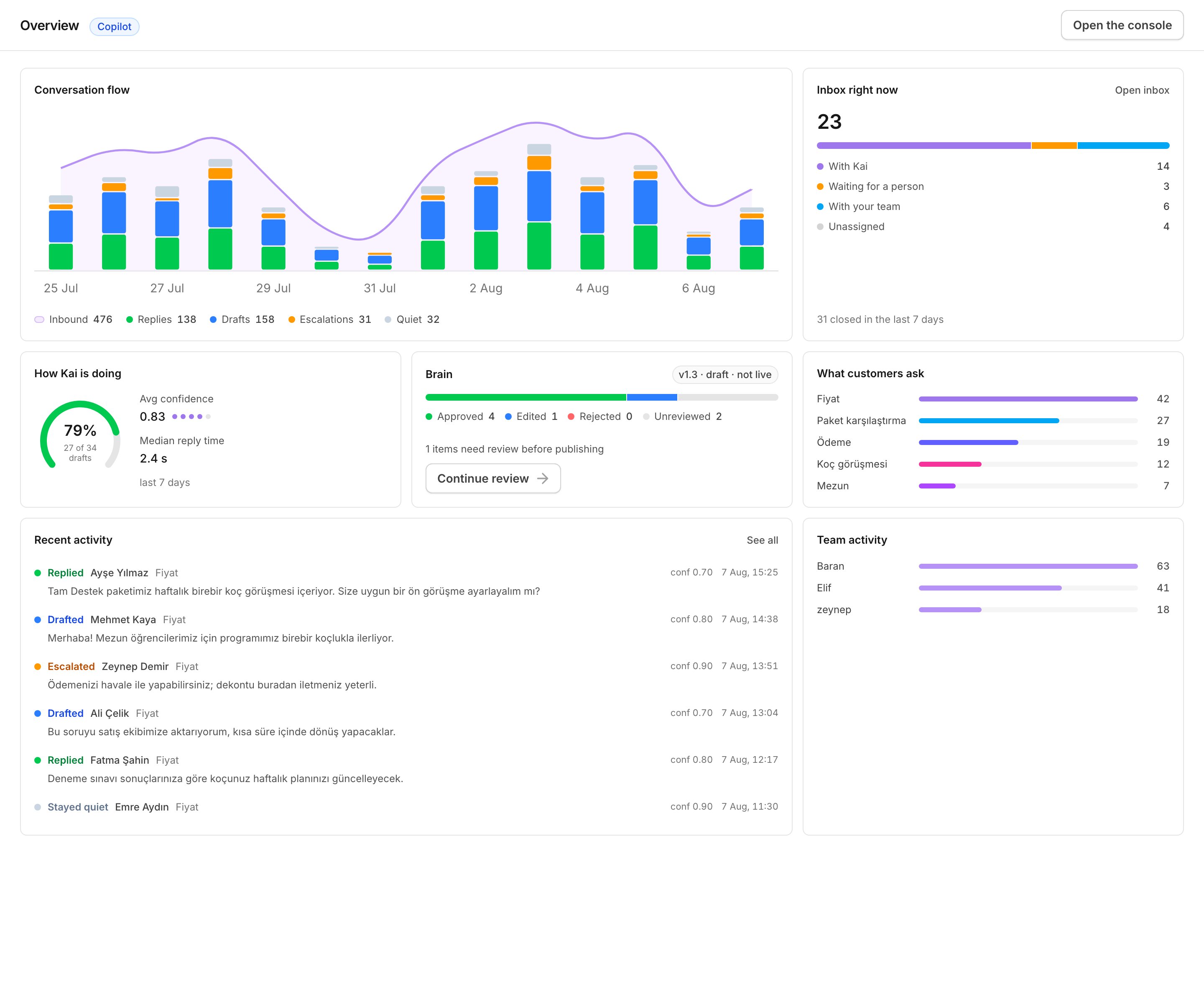 ## What a Brain is
A Brain is everything Kai is allowed to know and say. It has six parts, and you
can read and change each one:
| Part | What it holds |
| ----------------------- | --------------------------------------------------------------------------- |
| **Answer Library** | The answers to the questions your customers ask most often. |
| **Conversation Flows** | The steps Kai follows to guide a conversation to an outcome. |
| **Human Handoff** | The situations where Kai must stop and give the conversation to a teammate. |
| **Communication Rules** | What Kai must never say, and what it must always explain. |
| **Brand Voice** | The wording and the tone that keep every reply consistent. |
| **Current Information** | Live prices, links and payment details used inside answers. |
Kai writes the first version of each part from your history. Nothing in it can
reach a customer on its own until a person approves it.
A Brain is versioned: `v1`, `v2`, and so on. A published version is frozen. To
change a published version, you open a copy with **Edit as a new draft**, and
the copy becomes `v1.1`, `v1.2`, and so on. The published version keeps serving
customers until you publish the new draft.
## The two modes
Kai writes a draft and a coaching note in your inbox. A human reads it,
changes it if necessary, and sends it. Nothing reaches a customer unread.
Kai sends the reply itself. It does this only for content a reviewer
approved, or only for the intents you pick. Everything else still drafts or
escalates.
There is a third setting, **Off**. Kai watches and records, but never acts. It
is useful while your team reviews the Brain.
Even on autopilot, Kai writes a draft instead of sending when one of these is
true:
* a human handoff rule fires;
* the reply quotes a number that Kai cannot verify;
* confidence is below the floor you set;
* a human already replied on that conversation.
Read more in [Copilot, autopilot and off](/product/modes).
## Where Kai works
Kai works in the inbox your team already uses:
* **Intercom.** Drafts arrive as internal notes. A handoff is an assignment.
One Intercom workspace can carry the Messenger widget, WhatsApp, email and
SMS, and each of them can have its own mode.
* **WhatsApp Cloud.** A WhatsApp Business number talks to Kai directly.
* **Kai's own inbox.** WhatsApp Cloud has no provider inbox, so your team
answers from Kai. The inbox holds the conversation list, the thread, contact
details, assignment and delivery status.
## Your first hour
About two minutes.
A WhatsApp or an Intercom export is enough. Kai replaces every phone
number, email address and payment reference with a placeholder before any
model reads a word.
A few hundred conversations take a few minutes. You can close the tab.
Approve, edit or reject what Kai proposes. Work from the top: the queue
puts what blocks publishing first, then the most frequent items.
Your team reads every word Kai writes. The first drafts appear in the inbox
within minutes of the first customer message.
The full walkthrough is in [Get started](/product/getting-started).
## Next
The pipeline, one live message end to end, and what Brain versions mean.
From sign-up to the first draft, step by step.
A seven-page training path for the people who work the inbox every day.
What each mode does, and a safe order to turn them on.
Push, update, assign and export the contacts of your workspace.
## What a Brain is
A Brain is everything Kai is allowed to know and say. It has six parts, and you
can read and change each one:
| Part | What it holds |
| ----------------------- | --------------------------------------------------------------------------- |
| **Answer Library** | The answers to the questions your customers ask most often. |
| **Conversation Flows** | The steps Kai follows to guide a conversation to an outcome. |
| **Human Handoff** | The situations where Kai must stop and give the conversation to a teammate. |
| **Communication Rules** | What Kai must never say, and what it must always explain. |
| **Brand Voice** | The wording and the tone that keep every reply consistent. |
| **Current Information** | Live prices, links and payment details used inside answers. |
Kai writes the first version of each part from your history. Nothing in it can
reach a customer on its own until a person approves it.
A Brain is versioned: `v1`, `v2`, and so on. A published version is frozen. To
change a published version, you open a copy with **Edit as a new draft**, and
the copy becomes `v1.1`, `v1.2`, and so on. The published version keeps serving
customers until you publish the new draft.
## The two modes
Kai writes a draft and a coaching note in your inbox. A human reads it,
changes it if necessary, and sends it. Nothing reaches a customer unread.
Kai sends the reply itself. It does this only for content a reviewer
approved, or only for the intents you pick. Everything else still drafts or
escalates.
There is a third setting, **Off**. Kai watches and records, but never acts. It
is useful while your team reviews the Brain.
Even on autopilot, Kai writes a draft instead of sending when one of these is
true:
* a human handoff rule fires;
* the reply quotes a number that Kai cannot verify;
* confidence is below the floor you set;
* a human already replied on that conversation.
Read more in [Copilot, autopilot and off](/product/modes).
## Where Kai works
Kai works in the inbox your team already uses:
* **Intercom.** Drafts arrive as internal notes. A handoff is an assignment.
One Intercom workspace can carry the Messenger widget, WhatsApp, email and
SMS, and each of them can have its own mode.
* **WhatsApp Cloud.** A WhatsApp Business number talks to Kai directly.
* **Kai's own inbox.** WhatsApp Cloud has no provider inbox, so your team
answers from Kai. The inbox holds the conversation list, the thread, contact
details, assignment and delivery status.
## Your first hour
About two minutes.
A WhatsApp or an Intercom export is enough. Kai replaces every phone
number, email address and payment reference with a placeholder before any
model reads a word.
A few hundred conversations take a few minutes. You can close the tab.
Approve, edit or reject what Kai proposes. Work from the top: the queue
puts what blocks publishing first, then the most frequent items.
Your team reads every word Kai writes. The first drafts appear in the inbox
within minutes of the first customer message.
The full walkthrough is in [Get started](/product/getting-started).
## Next
The pipeline, one live message end to end, and what Brain versions mean.
From sign-up to the first draft, step by step.
A seven-page training path for the people who work the inbox every day.
What each mode does, and a safe order to turn them on.
Push, update, assign and export the contacts of your workspace.